
Hydrogen news
Groundbreaking Hydrogen-hybrid research vessel gets AIP
Glosten’s CCRV design has been given ABS approval. The American Bureau of Shipping (ABS) has awarded Approval in Principle (AIP) to Glosetn, an American naval architecture and marine engineering company, for the design of UC San Diego’s new hydrogen-hybrid Costal-Class Research Vessel (CCRV). Designed to meet multiple regulatory requirements. The preliminary design from the hydrogen-hybrid CCRV was completed in March by Glosten and Siemens Energy, which is the project’s electrical integrator. Being an uninspected, California Air Resource Board (CARB)-compliant, ABS-classed vessel as well as a…
Glosten’s CCRV design has been given ABS approval.
The American Bureau of Shipping (ABS) has awarded Approval in Principle (AIP) to Glosetn, an American naval architecture and marine engineering company, for the design of UC San Diego’s new hydrogen-hybrid Costal-Class Research Vessel (CCRV).Designed to meet multiple regulatory requirements.
The preliminary design from the hydrogen-hybrid CCRV was completed in March by Glosten and Siemens Energy, which is the project’s electrical integrator. Being an uninspected, California Air Resource Board (CARB)-compliant, ABS-classed vessel as well as an alternative design under SOLAS (Safety of Life at Sea), the CCRV faced “a complex regulatory regime”, according to Glosten. Before submitting the design for approval, Glosten managed to complete a week-long risk assessment workshop with the USCG, Scripps, and Siemens Energy, as well as major equipment providers Ballard Power System and Chart Industries. Receiving the greenlight from ABS demonstrates that the CCRV design meets the technical requirements and safety standards of ABS. It also validates the use of hydrogen fuel cell propulsion for medium-sized costal vessels.Once built, the hydrogen-hybrid research vessel will become the first of its kind in the world.
The early beginnings of the vessel came about in 2018 after Glosten, Scripps Oceanography, Sandia National Laboratories, and DNV carried out a feasibility study. The study assessed the technical, regulatory and economic feasibility of the Zero-V concept - A vessel that would be powered by fuel cells and liquid hydrogen and designed to meet Scripps-established performance and environmental criteria. [caption id="attachment_65551" align="aligncenter" width="1346"]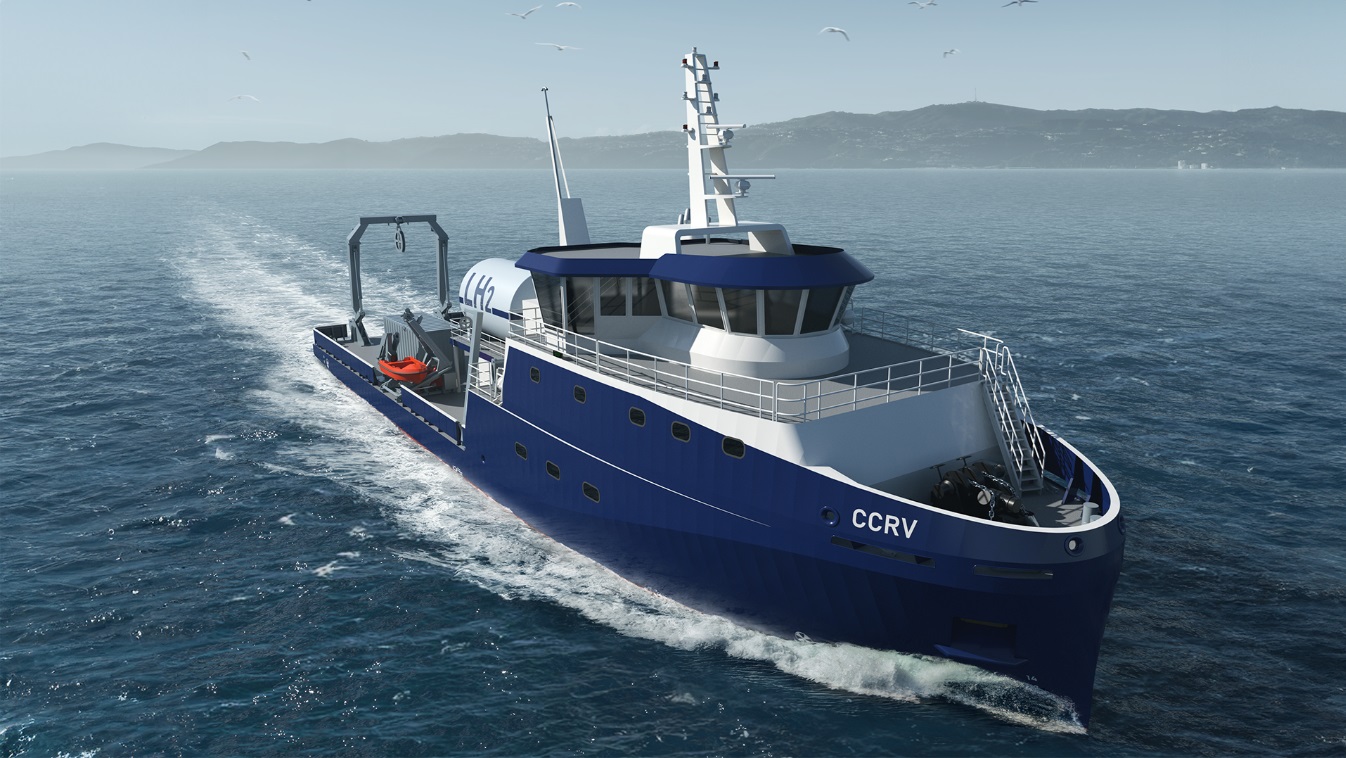 hydrogen-hybrid CCRV - Image source: Glosten[/caption]
Once it’s ready to go, Scripps Institution of Oceanography will operate the CCRV, the world’s first hydrogen-hybrid research vessel. The ship will be equipped with a hydrogen fuel cell propulsion system, resulting in zero-emission operation.
hydrogen-hybrid CCRV - Image source: Glosten[/caption]
Once it’s ready to go, Scripps Institution of Oceanography will operate the CCRV, the world’s first hydrogen-hybrid research vessel. The ship will be equipped with a hydrogen fuel cell propulsion system, resulting in zero-emission operation.
A world-class oceanographic research vessel.
The purpose of this hydrogen-hybrid research vessel is to help Scripps and its researchers study the marine ecosystem that exists along the California coast, and do so without harming the environment. “Our goal is to produce a fully capable ocean-going research vessel that meets the needs of our scientists and students,” said associate director of Scripps, Bruce Applegate, in a news release. Furthermore, the goal is to show that this research can be carried out in a way that “absolutely minimizes its impact on our environment,” Appelgate added. The next stage of the project is to progress the CCRV to a functional-level design before moving on to bid solicitation to make construction happen.How was this article?
Thanks for the feedback!