Monolayer Amorphous Carbon Emerges as a Metal-Free Catalyst Candidate for Hydrogen Production
IIT Gandhinagar researchers combined DFT and machine-learned potentials to screen monolayer amorphous carbon for HER, finding ~15% of sites match favorable adsorption energies for potential metal-free hydrogen production catalysts.
Researchers at the Indian Institute of Technology Gandhinagar in Gujarat have been diving deep into the world of monolayer amorphous carbon and its potential as a metal-free catalyst for the hydrogen evolution reaction (HER). Their recent findings, published in npj 2D Materials and Applications, bring together the power of first-principles simulations and machine-learned interatomic potentials to explore this material in a new light. By mixing density functional theory (DFT) with a finely-tuned MACE machine-learning potential, the team mapped out hydrogen-adsorption free energies across disordered carbon surfaces. The results were promising, revealing that about 15% of the sites they'd evaluated showed adsorption values below +0.25 eV, which is seen as a favorable range for effective catalytic activity.
With the increasing push for decarbonization in various industries, electrolytic hydrogen production is expected to grow significantly. However, traditional systems like proton-exchange-membrane (PEM) rely heavily on scarce resources like platinum and iridium for their electrodes. The issues that come with these scarce materials, including fluctuating prices and limited supply, can create significant challenges. This is where carbon-based catalysts come into play, presenting a more abundant and cost-effective alternative. Still, earlier efforts focused on defective graphene and doped carbons faced hurdles with stability, conductivity, and reproducibility. The research team from IIT Gandhinagar is now shifting the focus from well-ordered graphene structures to amorphous forms, claiming that a bit of controlled disorder—like bond distortions and non-hexagonal rings—can actually lead to better binding sites for hydrogen.
- Broad adsorption range: Using DFT calculations on 30 local environments, the team found ΔG_H values ranging from −0.02 to +1.35 eV. The MACE screenings widened this range to −0.91 to +1.70 eV.
- Active-site hotspots: They discovered that certain features—like seven-membered rings, curved areas, and distorted bonds—tend to correspond with lower adsorption energies.
- Comparative benchmark: In comparison, β-graphyne, which is a crystalline form of carbon, only managed a best ΔG_H of +0.34 eV, while around 15% of the MAC sites were below +0.25 eV.
- Machine-learning efficiency: The MACE potential proved to be effective, predicting adsorption energies with a mean absolute error of just 0.161 eV and managing to classify active vs. inactive sites with a solid 95% accuracy.
- Computational lead, not a device: They haven't reported any actual electrolyzer data or hydrogen yield results yet—experimental validation is still on the checklist.
Computational Approach and Findings
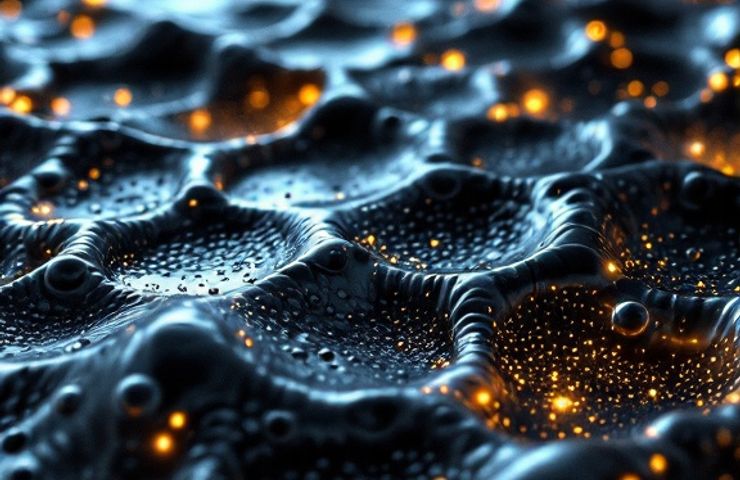
The researchers kickstarted their investigation by generating monolayer amorphous carbon structures using melt-quench simulations, which mixed sp2 and sp3 bonding types along with a mix of five-, six-, and seven-membered rings. They initially used DFT calculations to examine 30 different surface sites, gauging the Gibbs free energy (ΔG_H) for hydrogen adsorption. The sweet spot for binding hydrogen seems to be those sites that hold onto it just right—not too tightly, but not too loosely either—ideally hanging around ±0.2 eV from thermoneutral. The calculated ΔG_H ranged from slightly exergonic (−0.02 eV) to endergonic (+1.35 eV).
To ramp up their screening, the team refined a MACE interatomic potential based on the DFT results and applied it to over a thousand local configurations on larger models of MAC. This fine-tuning helped ensure reliable energy predictions with a reported mean absolute error of just 0.161 eV, while also distinguishing between likely active sites with an impressive 95% accuracy. The expanded screening revealed a broader ΔG_H distribution (−0.91 to +1.70 eV), showcasing about 15% of sites falling below +0.25 eV—a threshold the researchers highlight as promising for HER activity. Interestingly, they found that those seven-membered rings and areas with surface curvature gave the best adsorption energies, challenging the belief that a perfectly ordered hexagonal structure is the best option.
Strategic Implications for Catalyst Supply Chains
Shifting away from platinum-group metals for electrodes could significantly alleviate cost pressures and the risks associated with the supply chain for green hydrogen initiatives. Both government and industry roadmaps for PEM electrolyzers regularly point out platinum and iridium as potential chokepoints. If carbon-based catalysts can be produced at scale and boast sufficient conductivity and stability, they could drastically reduce material costs and broadening the range of suppliers involved. However, developing monolayer amorphous carbon electrodes would require:
- Reliable synthesis methods that can control ring statistics, bond angles, and surface rippling.
- Integration into electrode designs that minimize contact resistance and maximize access to active sites.
- Durability under demanding conditions, including high current densities and both acidic and alkaline electrolytes over long durations.
Also, cost models must take into account the energy-intensive aspects of production, such as processing steps, solvents, substrates, and membrane compatibility. Until experimental data on HER rates, overpotentials, and Faradaic efficiencies are collected, the true commercial viability of MAC remains uncertain.
Next Steps and Research Outlook
The authors emphasize that while the calculated adsorption energies provide useful insights, they're just one piece of the catalytic performance puzzle. Other factors like kinetic barriers, charge transport, and gas evolution dynamics still need thorough investigation. Future research teams might want to focus on synthesizing MAC through methods like chemical vapor deposition, laser ablation, or templating routes while correlating structural insights with electrochemical performance.
Combining high-throughput screening methods in flow cells with operando spectroscopy will be crucial for assessing whether those promising seven-membered rings and surface ripples can withstand real-world operating conditions.
On the backend, machine-learning frameworks like MACE are showing how computational tools can effectively guide material discovery, allowing researchers to narrow down the candidate pool before diving into experimental work. Cross-disciplinary collaboration will be key in translating these computational leads into practical electrodes, ensuring a seamless connection between theory, synthesis, and device engineering.
Key Takeaway: Monolayer amorphous carbon stands out as an exciting computational lead for metal-free HER catalysts, with roughly one in six sites matching or surpassing the free-energy criteria of platinum-group materials. However, turning this promise into durable, scalable electrodes will require serious experimental effort and comprehensive techno-economic evaluations before it can step into the shoes of existing PEM technologies.