Hydrogen news
A lack of public education is standing in the way of green hydrogen adoption
Recent HFN results show that what people don’t know might be hurting H2 use worldwide. In a recent survey looking into the largest barrier standing in the way of increased use of green hydrogen worldwide, a lack of public education on the subject of H2 took the top spot. There survey involved the participation of 2,018 people from countries around the world. The Hydrogen Fuel News survey showed that while there are a handful of reasons that have stopped green hydrogen from taking off more quickly than it has, a lack of public education is by far the main blockage standing in the way. Of the 2…

Recent HFN results show that what people don’t know might be hurting H2 use worldwide.
In a recent survey looking into the largest barrier standing in the way of increased use of green hydrogen worldwide, a lack of public education on the subject of H2 took the top spot.There survey involved the participation of 2,018 people from countries around the world.
The Hydrogen Fuel News survey showed that while there are a handful of reasons that have stopped green hydrogen from taking off more quickly than it has, a lack of public education is by far the main blockage standing in the way. Of the 2,018 participants, 594 (29.4 percent) said that they felt that “Lack of public education” represented the “Biggest problem stopping the world from using more green hydrogen.”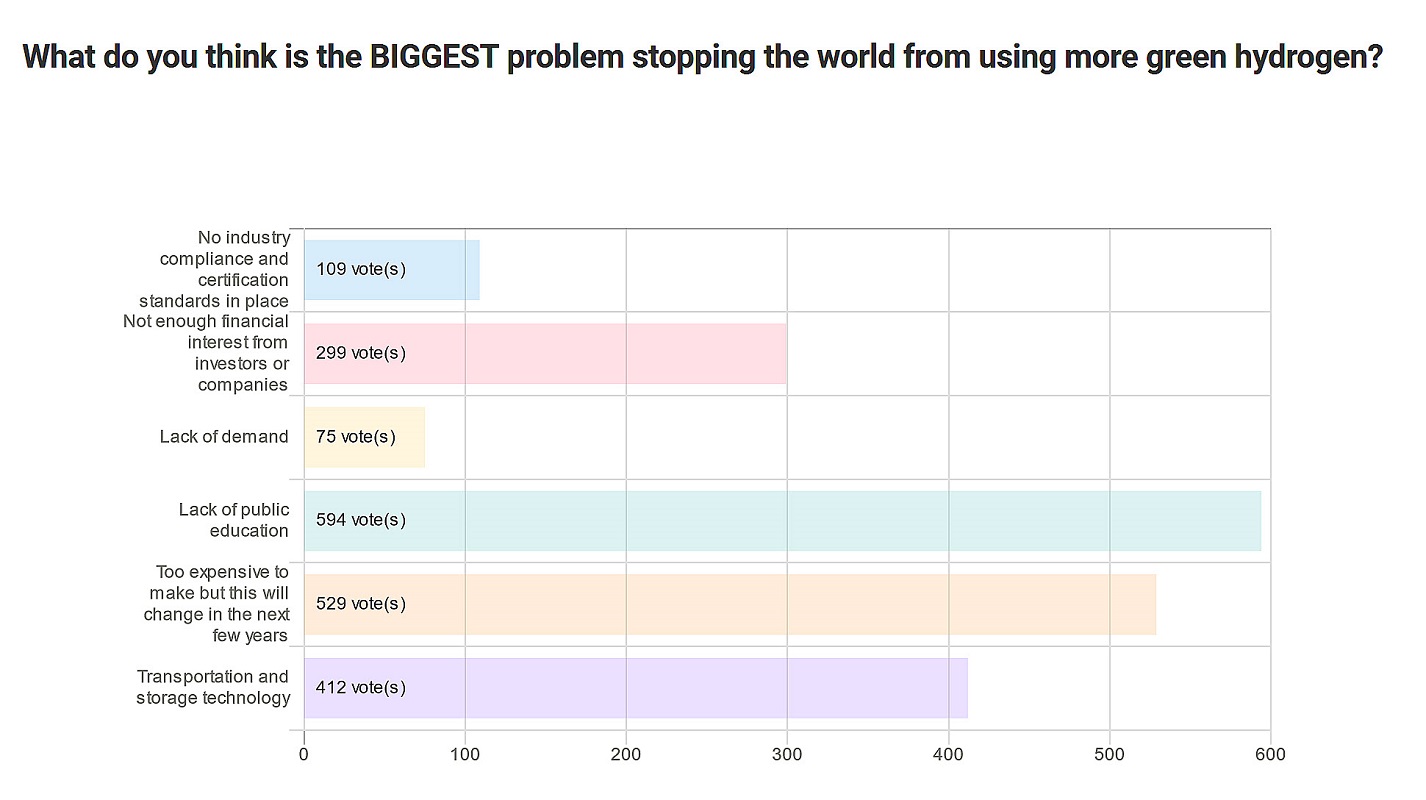 The second largest problem stopping the world from using more renewable H2 was that it is currently “too expensive to make, but this will change in the next few years.” This showed that while the cost of the fuel is indeed an issue, 529 of the respondents (26.2 percent) feel that this is a barrier that will naturally fade in coming years.
Well over half of the respondents think green hydrogen will become more affordable but needs awareness.
Aside from the top two, other problems standing in the way of renewable H2’s faster adoption worldwide included:- Transportation and storage technology problems – 412 respondents (20.4 percent).
- Not enough financial interest from investors or companies – 299 respondents (14.8 percent).
- No industry compliance and certification standards in place – 109 respondents (5.4 percent).
- Lack of demand – 75 respondents (3.7 percent)[aweber listid="6179904" formid="497551345" formtype="webform"]
How was this article?
Thanks for the feedback!