Dense Palladium Membrane Enhances Hydrogen Production Methods for Green Ammonia Synthesis
Korean teams showed a dense palladium membrane that transports protons and blocks water in an ammonia cell, achieving 51% Faradaic efficiency over 12 hours, the paper reports.
Researchers at the Korea Institute of Energy Research, in collaboration with Seoul National University and Chungnam National University, have demonstrated a dense palladium membrane that shuttles hydrogen-derived protons between aqueous and non-aqueous compartments while suppressing water and molecular crossover in a continuous-flow electrochemical cell. This laboratory proof of concept marks an advance in hydrogen production methods and green hydrogen production, according to their peer-reviewed paper in Advanced Science.
How the Palladium Membrane Works
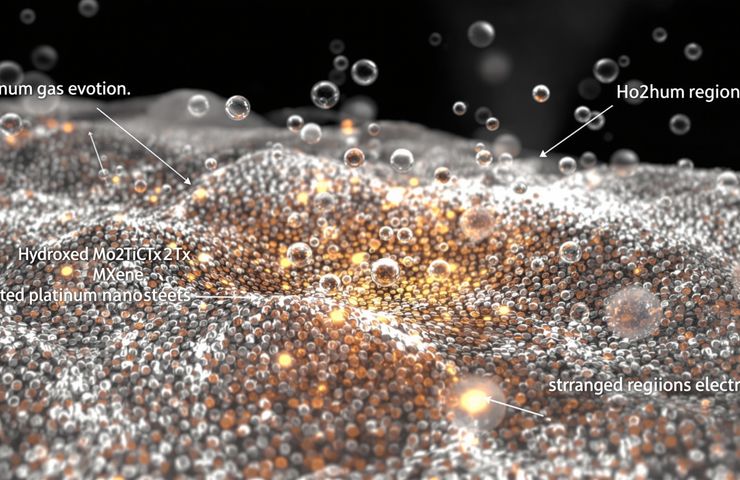
At the center of the work is a bipolar palladium membrane — a dense metal foil used in place of conventional polymer ion-exchange separators. In the aqueous compartment, an oxygen evolution reaction oxidizes water at an iridium-oxide catalyst, generating protons and oxygen gas. Under an applied potential, those protons at the palladium surface gain electrons and are absorbed as hydrogen atoms into the metal lattice, forming palladium hydride (PdHx). The absorbed atoms then diffuse through interstitial sites in the foil and emerge on the catholyte side. There, hydrogen atoms are desorbed as protons into the non-aqueous electrolyte. Because the membrane is dense rather than water-filled, bulk water, organic solvents, and larger molecules have few pathways to cross; the design therefore effectively isolates the water-sensitive chemistry on the cathode. Control experiments with platinum and nickel foils did not show the same proton-shuttling behavior, the authors report, highlighting palladium’s unique absorption and diffusion properties. The study further includes position-resolved potential measurements across the foil under steady-state current to confirm localized proton transport, and hydrogen preloading tests that sustain the hydride phase for improved performance.
Integration into Electrochemical Ammonia Synthesis
The team incorporated the membrane into a continuous-flow ammonia electrolyzer that links aqueous water oxidation with non-aqueous lithium-mediated nitrogen reduction. In that configuration, nitrogen gas is fed to a gas-diffusion cathode immersed in an organic electrolyte containing a lithium salt and a proton carrier. As lithium deposits activate nitrogen, protons supplied through the palladium membrane react with nitrogen intermediates to form ammonia. Bulk water intrusion can alter the cathode’s solid-electrolyte interphase and trigger competing hydrogen evolution reactions, which reduce selectivity. By segregating the aqueous and organic compartments and maintaining catholyte water content below 0.01% of its volume, the design prevents water crossover and helps preserve interphase stability and high ammonia selectivity over hours of operation. The paper notes that this approach addresses a key challenge for ammonia and potential downstream applications in hydrogen storage and as a hydrogen carrier for transport, including hydrogen vehicles and hydrogen cars.
Performance and Stability Tests
Under potential cycling, the researchers report 51% ammonia Faradaic efficiency over a 12-hour run, with catholyte water content held at 105 parts per million. In a separate trial using a diglyme-based catholyte, the cell operated for roughly 79 hours and maintained 50% efficiency after 72 hours, but experiment termination occurred when the catholyte gelled and blocked flow channels. The authors also observed membrane surface roughening, electrolyte-derived deposits, and approximately 5 ppm of dissolved palladium in the catholyte after extended operation. A calculated full-cell energy efficiency of 10.1% under the tested conditions indicates room for improvement but confirms the membrane’s function. Taken together, these findings demonstrate a prototype approach to real-world clean hydrogen news devices while flagging critical factors for future scale-up.
Remaining Challenges and Outlook
Despite its promise, the palladium membrane system faces several hurdles on the path to practical adoption. Palladium is a high-value precious metal, so reducing foil thickness, exploring supported or alloyed structures, and implementing effective recycling strategies will be essential to lower material costs, the paper notes. The catholyte gelation that ended the 79-hour test underlines the need for optimized flow cell engineering and electrolyte formulation to prevent blockage. Membrane surface roughening and electrolyte-derived deposits also point to durability concerns that must be addressed through corrosion-resistant coatings or periodic cleaning protocols. Scaling to higher current densities and improving full-cell energy efficiency will require careful electrode design and thermal management. The authors suggest future studies could evaluate alternative metal hydrides or composite separators that retain proton-shuttling capabilities while using less precious metal. Advancing these aspects will be critical to integrate the membrane into robust hydrogen infrastructure.
Toward Sustainable Ammonia and Hydrogen Systems
The proton-shuttling mechanism demonstrated by the palladium membrane may have broader implications across the clean hydrogen news and hydrogen energy news landscape. Beyond water-fed ammonia synthesis, similar separators could benefit membrane-separated hydrogen production methods that require strict solvent or reactant isolation. Potential applications include electrocatalytic hydrogen storage systems, electrochemical hydrogen purification for fuel cell-grade hydrogen, and redox-flow battery architectures where crossover of active species must be minimized. Ammonia itself is under consideration as a long-distance hydrogen carrier and fuel for sectors such as power generation or hydrogen vehicles, and selective proton transport could enhance onsite ammonia cracking or reconversion processes. As renewable electricity becomes more available, integrating modular reactors that employ dense metal membranes could support decentralized production and distribution networks, complementing emerging hydrogen infrastructure and green data centers. The authors suggest that modular units employing this membrane could integrate with emerging hydrogen refueling stations and benefit from supportive hydrogen project financing to accelerate deployment.
Bottom line, this study introduces a proton-shuttling mechanism that could inform next-generation hydrogen production methods and support the transition to low-carbon ammonia and hydrogen services. Continued development will be critical to address cost, durability, and performance barriers before dense metal separators can find a place in practical, scalable decarbonization solutions.