Wood Secures FEED Contract for BarMar Subsea Hydrogen Pipeline Connecting Spain and France
Wood has been awarded a FEED contract for the BarMar hydrogen pipeline, linking Barcelona, Spain, to Fos-sur-Mer, France, part of the H2med initiative to enhance Europe's hydrogen infrastructure.
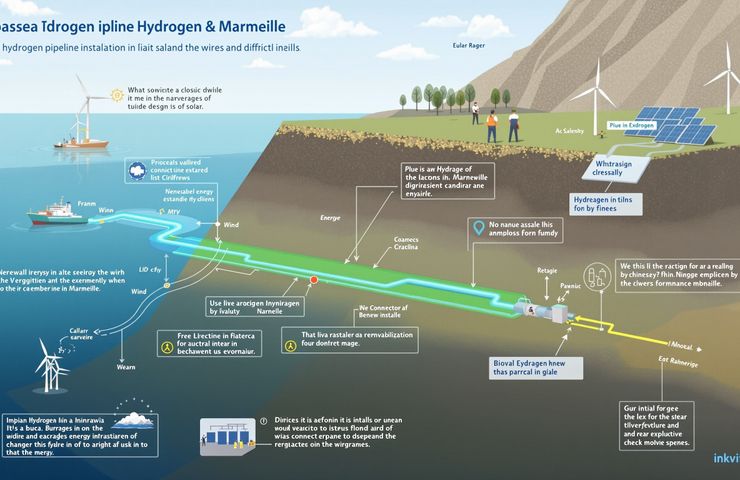
Engineering company Wood has been awarded a Front-End Engineering Design (FEED) contract for the BarMar hydrogen pipeline, a planned subsea connection linking Barcelona, Spain, to the Fos-sur-Mer industrial area near Marseille, France. The contract was detailed recently and emphasizes Wood’s role in developing the engineering aspects related to subsea pipeline design and hydrogen infrastructure through several critical services. The work covers early-stage technical definition rather than construction, and it is intended to establish the parameters that would inform later permitting, procurement and investment steps.
The BarMar pipeline forms one component of the wider H2med initiative, which aims to create a comprehensive European hydrogen corridor. That corridor is intended to facilitate the transmission of renewable hydrogen produced in the Iberian Peninsula to industry and markets in France, Germany, and beyond. H2med is presented as a strategic framework for linking production centers in Spain and Portugal with demand centers further north, enabling larger-scale trading and movement of hydrogen across national borders within Europe.
Strategic Implications
The pipeline is designed with a capacity of up to 2 million tonnes of hydrogen per year. At that scale, project planners expect the route to serve energy-intensive sectors where direct electrification is difficult, including chemicals, steel and heavy transport. Those sectors are specifically singled out as potential primary users because their processes and transport needs make alternatives to hydrogen harder to implement in the near term.
Beyond supplying particular industries, the BarMar route is described as a mechanism to improve energy security and operational flexibility across participating regions. By creating a direct subsea link between the abundant solar and wind resources of Spain and Portugal and northern Europe’s industrial clusters, the project seeks to reduce reliance on maritime imports and on less efficient transportation routes. In turn, proponents say this physical connection could support the development of a more integrated hydrogen market across multiple countries.
Technical Overview
The FEED scope awarded to Wood covers a range of engineering tasks. Key items listed include subsea pipeline design, compression facilities, microtunnelling techniques and broader hydrogen infrastructure services. Those elements are intended to establish how the pipeline will operate, what technologies will be required and how the system will be sited to meet safety and environmental constraints.
- Subsea pipeline design: Engineering solutions tailored for hydrogen compatibility. This work addresses the particular material, flow and integrity considerations that a dedicated hydrogen pipeline presents compared with conventional natural gas or liquid services.
- Compression facilities: Essential for maintaining hydrogen flow and meeting pressure requirements. The FEED will define the type and scale of compression needed along the route to ensure continuous delivery at the target capacity.
- Microtunnelling techniques: Used for sensitive crossings and minimized surface disturbance. These methods are included to navigate urban and environmentally sensitive areas with reduced impact relative to open-cut crossings.
- Hydrogen infrastructure services: Integrated solutions to support the dedicated hydrogen pipeline. The FEED will also consider connections to existing industrial sites, interfaces with onshore infrastructure and logistical arrangements needed for operation and maintenance.
Those technical tasks must contend with a number of complex challenges. Route selection will require balancing engineering practicability with environmental, social and regulatory constraints. Material specifications will need to address hydrogen’s effects on metals and seals. Safety protocols must be developed to cover subsea operation, onshore tie-ins and contingency planning. Only after those technical definitions are sufficiently mature can public consultations and environmental assessments proceed in an informed way.
Current Project Status
Receiving the FEED contract represents a pivotal engineering step for BarMar, but it does not mean the pipeline is operational or that financing for construction is in place. Several essential conditions remain outstanding: environmental evaluations, public approvals and final investment decisions are all listed as pending. In other words, the FEED establishes a design baseline but does not itself commit the partners to build.
The current phase is an engineering study expected to run until April 2028. During that period, roughly 50 Wood employees are scheduled to work on the design. The staffing level is intended to produce the technical documentation, studies and specifications that would be used by regulators, potential investors and construction contractors should the project advance to later stages. The experience gathered by the Wood team through this assignment is also noted as likely to be useful in future pipeline and hydrogen infrastructure projects.
European Union Involvement
BarMar has been classified as a Project of Common Interest (PCI) within the European Union framework. That designation is meant to support expedited permitting processes and to improve access to EU infrastructure funding for selected projects. In this context, the pipeline sits within the EU’s broader policy emphasis on hydrogen initiatives, which the European institutions link to long-term decarbonization and enhanced energy resilience.
Being a PCI does not remove the need for standard environmental reviews or public consultation, but it is designed to streamline certain administrative steps and to signal policy support at the EU level. Project sponsors and regional stakeholders will still need to demonstrate environmental compliance, secure the necessary national approvals and confirm investment arrangements before construction can begin.
Future Outlook
The BarMar proposal represents a concrete attempt to connect generation-rich regions in the southwest of Europe with industrial demand further north. If it proceeds, the project would form one element of a larger move toward an integrated hydrogen economy across multiple sectors. Stakeholders will monitor the engineering outputs, the outcome of environmental reviews and the progress of financial decisions as indicators of the pipeline’s feasibility.
In short: engineering is now under way, but significant steps remain before the subsea link becomes a built asset. The FEED will produce the technical groundwork; subsequent approvals and investment choices will determine whether the BarMar pipeline moves from design into construction and operation. Its successful implementation, proponents say, has the potential to reshape regional energy connections and to support broader hydrogen utilization across chemicals, steel, heavy transport and other hard-to-electrify industries.