Strain-Engineered Cu₃Pt Catalyst Cuts Platinum by 75% in Hydrogen Fuel Cell Cathodes
IMDEA Materials researchers have shown that a strain-engineered Cu₃Pt catalyst on a NiTi substrate delivers Pt-level ORR performance at just 25% of the platinum load, pointing to a new route for lower-cost, durable PEM fuel cell cathodes.
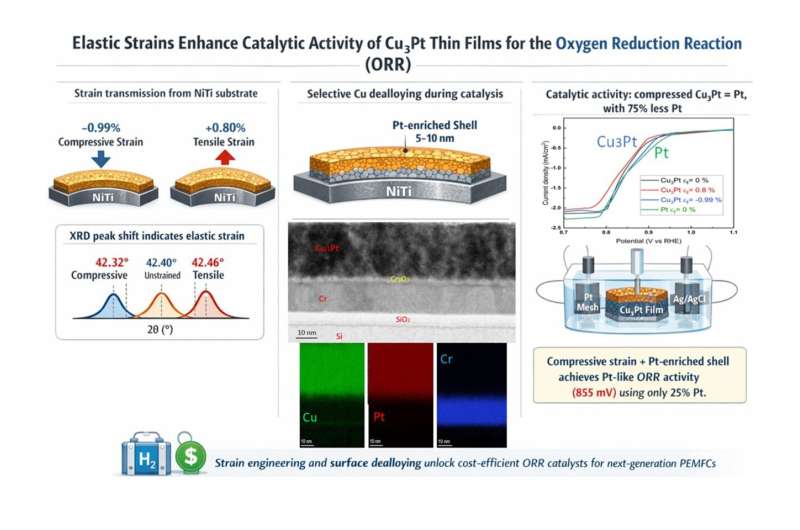
The IMDEA Materials Institute in Madrid have just unveiled an exciting breakthrough: a copper-platinum (Cu₃Pt) alloy thin-film catalyst. This innovative catalyst, when placed on a special nickel-titanium shape-memory substrate and squeezed just a tad—less than 1%—matches the oxygen reduction reaction (ORR) performance of pure platinum while using only a quarter of the platinum. How amazing is that?
When tested at 1 mA/cm² in an acidic environment, the compressed Cu₃Pt recorded an impressive 855 mV compared to 856 mV for pure platinum. Led by Jorge Redondo, this study published in Electrochimica Acta opens up exciting new possibilities in the realm of electrocatalysis for proton exchange membrane (PEM) fuel cells.
When Mechanics Meets Chemistry
Typically, PEM cathodes rely on platinum nanoparticles supported by carbon, where the electronic structure plays a huge role in determining ORR kinetics. But instead of merely tweaking compositions, the team at IMDEA is taking a fresh approach with elastic strain engineering. By applying a uniform strain to a continuous Cu₃Pt film on a NiTi substrate, they’re optimizing the adsorption energies for important reaction intermediates in ORR.
Interestingly, they found that applying tensile strain (around 0.8%) actually hurt performance, which confirms their theory about the relationship between strain and activity. Plus, when they cycled the catalyst in acid, it selectively dissolved some surface copper, creating a super-thin platinum-enriched layer that could enhance mass activity and potentially improve durability. Talk about clever chemistry!
Collaboration and Funding Opportunities
Now here’s where it gets even more exciting: the IMDEA Materials Institute is part of a bigger network known as the Madrid Institutes for Advanced Studies, receiving support from both regional and EU funds. They’re teaming up with universities, industry experts, and international research centers through Horizon Europe projects focused on sustainable mobility and energy. And guess what? Industrial players are now looking into pilot projects and consortium models to use these NiTi-based substrates in catalyst inks, with an eye on testing prototypes at hydrogen refueling stations!
The Ripple Effect on Hydrogen Infrastructure
Why does this matter? Well, platinum is a major factor in the cost of PEM stacks, which has been holding back the adoption of fuel cell technology for cars, backup power, and industrial decarbonization. A catalyst that slashes platinum usage to just 25% could significantly reduce the cost per kilowatt, making green hydrogen production much more economical, along with hydrogen storage solutions and offtake agreements.
Less demand for platinum also minimizes supply chain vulnerabilities associated with limited mining regions. As we ramp up clean hydrogen in applications like ammonia synthesis or powering hydrogen data centers, these strain-optimized catalysts might help make a stronger business case for wider clean hydrogen deployments.
Policy and Market Implications
Looking at the bigger picture, global policies from the U.S. Department of Energy all the way to the European Green Deal aim to cut platinum loadings to around 10 grams per 100 kW while ensuring thousands of hours of stability. If these elastic strain–engineered catalysts prove durable under real-world conditions, they could help meet those cost and longevity targets, which might shift future research and development funding and policy direction.
Environmental and Lifecycle Advantages
Using less platinum doesn’t just make financial sense; it also helps lower the environmental footprint of fuel cell production. Mining and refining platinum can be pretty energy-intensive and environmentally damaging. So, reducing platinum needs for everything from green hydrogen production to hydrogen fuel cell vehicles can lead to lower lifecycle emissions and conserve resources. When coupled with effective recycling and advanced hydrogen storage methods, this strategy aligns perfectly with circular economy principles and boosts the adoption of clean hydrogen.
Challenges Ahead for Commercialization
Now, translating these thin-film results to more complex, porous, carbon-supported electrodes is going to be a challenge. We'll need some fresh manufacturing techniques like roll-to-roll deposition and new mechanical setups, plus realigning supply chains for those NiTi materials. Plus, we have to ensure that the compressive strain can withstand thermal changes, humidity, and mechanical stresses in full membrane electrode assemblies (MEAs)—that’s still unproven.
While those dealloyed platinum skins might boost early performance, they come with their own set of risks, like copper dissolution and structural shifts over time. Gathering long-term stability data—like how performance holds up and the cycle life—will be crucial to proving that this approach can indeed work on a commercial scale.
Where This Research Fits in Catalyst Development
For years, efforts to reduce platinum usage have revolved around alloying techniques and non-precious catalysts. What the IMDEA study adds to the mix is this cool new dimension—mechanical strain—that’s backed up by experimental validation of strain-activity theories. This mechanical approach could work alongside traditional methods focusing on composition and design, and might even integrate well with emerging non-precious metal catalysts.
What’s Next?
The next big hurdle is figuring out how to embed this elastic strain into high-surface-area nanoparticle inks and porous supports. Showing that these performance boosts hold up at larger, automotive-scale current densities and higher temperatures is going to be the real test. If successful, we could see a total rethink of PEM electrode designs, incorporating pre-stressed supports or actively mechanical components into MEAs.
As hydrogen fuel cell vehicles and battery electric options jockey for market dominance, and as industries search for reliable, zero-emission backup energy, innovations in catalysts that significantly cut platinum reliance will be essential. Elastic strain engineering shines as a promising path to bring PEM fuel cells closer to cost and durability parity, paving the way for a robust hydrogen infrastructure.