South Korea Unveils World's Smallest Semiconductor for Solar Hydrogen Production
South Korea's DGIST unveils the world’s first stable quantum semiconductor nanocluster for solar hydrogen production. Field testing begins Q3 2025 at POSCO, aiming to cut costs by 40%.
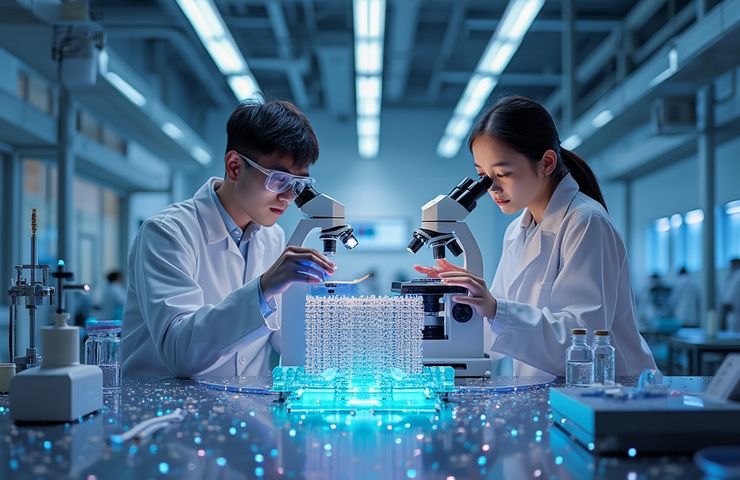
Researchers in South Korea have just pulled off something big — they’ve developed the world’s first stable quantum semiconductor nanocluster (CdSe)₁₃. And no, this isn’t just another lab flex. This breakthrough directly targets the toughest challenges in green hydrogen production: keeping things efficient and stable. The findings, published in May 2025 and led by Professor Jiwoong Yang from Daegu Gyeongbuk Institute of Science & Technology (DGIST), could slash the cost of making hydrogen by up to 40%. Even better? It opens the door to redesigning how photochemical reactors work.
Key Things to Know
- First-ever stable (CdSe)₁₃ nanocluster successfully synthesized
- Cobalt-doped 3D superstructure boosts quantum stability and improves charge flow
- Engineered for use in photocatalytic water splitting — basically turning sunlight into hydrogen
- Backed by South Korea’s Green Hydrogen 2030 Initiative
- Real-world testing kicks off at POSCO’s Gwangyang Steel Plant in late 2025
The Science — But Make It Practical
Let’s break it down. The tiny (CdSe)₁₃ nanocluster has just 26 atoms and measures under 1 nanometer — yep, we’re talking seriously tiny stuff here. That tiny size gives it something called a quantum confinement effect, which basically means it’s a champ at soaking up light and moving charges around effectively. That’s exactly what you need for making hydrogen out of water and sunlight.
Before now, photocatalysts this small were too unstable to get the job done. But DGIST’s team found a workaround: they embedded the cluster in a tough cobalt-doped 3D ligand structure. That kept the quantum properties intact and ramped up charge transfer — something earlier attempts had repeatedly failed to solve.
This wasn’t a solo act either. Professor Yoonjung Jang from Hanyang University’s Chemical Engineering Department played a key role in stabilizing the nanocluster’s chemistry, while Professor Stefan Ringe at Korea University used quantum modeling to fine-tune how energy moves through the system.
From Lab Bench to Steel Plants
Here’s where it gets exciting: this isn’t just theoretical. The new catalyst is headed for prime time. They’re rolling out pilot testing at POSCO’s Gwangyang Steel Plant later this year. That’s a major step — it’ll show if this innovation can actually handle the real-world chaos of an industrial setting.
Why does this matter for the bottom line? Because the new catalyst could help shrink hydrogen production systems and make them more energy-efficient, especially when they’re powered by sunlight. According to the DGIST team, this tech could cut hydrogen production costs by up to 40% compared to today’s standard electrolysis methods. If that holds up, it’s a serious boost for industrial decarbonization, especially in high-emission sectors like steel and chemical processing.
Why You Should Care
- Solves two long-standing problems: photocatalyst instability and weak charge transfer
- Succeeds where big-name projects from Cambridge (2018) and Tokyo Tech (2021) fell short
- Puts South Korea in the driver’s seat on quantum semiconductor and hydrogen production R&D
- Patent already filed in South Korea (KR2025-0056789)
- Could also shake things up in quantum computing and next-gen solar panels
Looking Ahead: What This Means Strategically
This isn’t just a cool science story — it’s a glimpse at how South Korea's big bet on the Green Hydrogen 2030 Initiative is starting to pay off. If the POSCO trial proves successful, we could see the rise of local manufacturing lines dedicated to these sub-nanoscale catalysts and a whole new supply chain for on-site hydrogen generators. That could seriously shake up the current hydrogen playbook, especially in sun-drenched regions across Asia, the Middle East, and Latin America where solar-powered photocatalytic water splitting makes a ton of sense.
The Big Picture
Here's the bottom line: every once in a while, research makes a leap that actually feels like the future knocking on the door. That’s what’s happening here. This tiny (CdSe)₁₃ nanocluster — crafted through smart collaboration between top Korean universities and backed by national R&D — isn’t just a scientific win. It might just become the new gold standard for high-efficiency, affordable solar hydrogen generation. And if it passes real-world testing this year, the whole clean energy game could get a serious upgrade.