Japan Launches Major Hydrogen Fuel Cell Truck Subsidy to Transform Commercial Transport by 2030
Japan is launching hefty subsidies to slash hydrogen fuel costs for trucks—cutting diesel parity gaps and aiming for 17,000 FCVs on the road by 2030. Backed by Toyota, Yamato, and SMBC, it's a bold play to keep Japan's auto sector global and green.
Japan is doubling down on hydrogen fuel cell technology with its boldest move yet—a major new subsidy designed to close the cost gap between hydrogen and diesel, especially for commercial transport. Rolled out in May 2025, the plan is backed by the Ministry of Economy, Trade and Industry (METI), and it’s set to cover up to 75% of the difference in hydrogen fuel costs—that’s about ¥700/kg—at 90 refueling stations spread across six key regions.
Big Goals, Bigger Infrastructure: A Push for Hydrogen on the Roads
This isn’t just another emissions plan—it’s a major pivot. METI is aiming to supercharge Japan’s adoption of zero-emission fuel cell vehicles (FCVs), starting with heavy-duty trucks. There are only about 160 of these trucks out there in Japan right now, but the goal? A massive ramp-up to 17,000 FCVs by 2030.
While battery electric vehicles (BEVs) are gaining traction, FCVs are carving out a niche—especially in sectors where long-haul routes, fast turnaround, and tight delivery schedules matter. With refueling times of around five minutes and the ability to go roughly 600km on a full tank, FCVs make a lot of sense for logistics and freight carriers. That’s a huge edge over BEVs, which need about three hours to charge and usually max out around 300km per charge.
Behind the Shift: Fuel Cell Tech and Smart Infrastructure
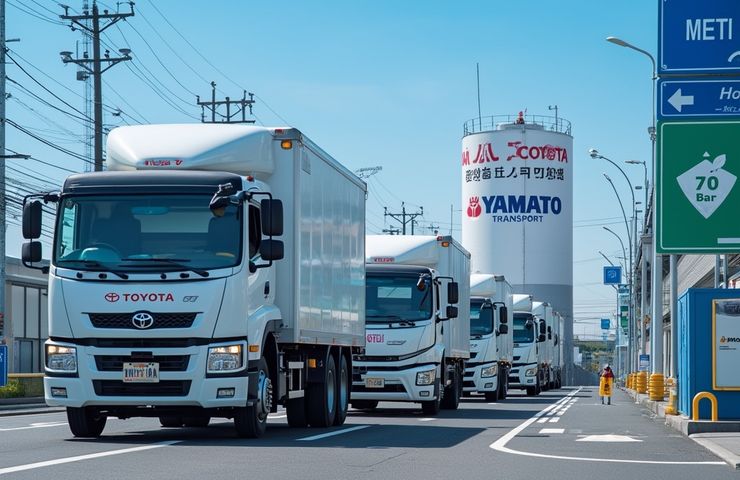
The rollout isn’t just about pumping subsidies—it’s backed by solid tech. Japan is banking on innovations like High-Pressure Hydrogen Storage with 700-bar composite tanks, and Toyota’s next-gen fuel cell stacks, which are now 15% more efficient and use less platinum than before. These advances aren’t staying in the lab either—they’re already being tested out in real-world trials with Yamato Transport and Hino Motors along the Tokyo-to-Nagoya corridor.
The first wave of hydrogen refueling hubs will roll out in industrial strongholds like:
- Aichi Prefecture – Where Toyota’s headquarters and Japan’s auto industry giants are based
- Fukushima Prefecture – Rebuilding with a green energy focus, home to the Fukushima Hydrogen Energy Research Field
Why Now? Global Competition and Local Urgency
This isn’t just about cleaner air; it’s also smart economic strategy. Japan’s auto industry is feeling the heat from China’s fast-moving fuel cell technology developments. By helping close the fuel cost gap, METI is giving domestic players a fighting chance. The bigger picture? A 2026 carbon pricing plan that will make diesel incrementally less attractive and pave the way for a broader shift.
Backers like Sumitomo Mitsui Banking Corporation (SMBC) are all in. They predict that the cost of producing green hydrogen could drop by 60% by 2030—especially with supply deals from Australia, where renewables are driving the costs of electrolysis way down. That’s a game-changer for hydrogen infrastructure in Japan.
All Hands on Deck: Industry Players Step Up
No single player could drive this transition alone, and that’s why a coalition of heavy-hitters is on board:
- Toyota – A pioneer in fuel cell vehicles since 2002
- Yamato Transport – Using FCV trucks in delivery trials since 2022
- Hino Motors – Producing FCVs for commercial use
- Japan Post – Testing FCVs in last-mile delivery routes
This strategy isn’t being built from scratch—it’s building on the lessons of Japan’s groundbreaking 2017 Basic Hydrogen Strategy and the public FCV showcases during the 2020 Tokyo Olympics. What’s different now is that climate goals are becoming industrial goals. This is industrial decarbonization in action.
Ripple Effects: Local Rollout, Global Shockwaves
This move could reshape more than just Japan’s roads. Scaling up hydrogen means less reliance on LNG, shaking up Asia’s energy game. The race between hydrogen fuel cells and lithium-ion batteries is heating up too, especially in freight markets where weight and space make batteries less practical. FCVs could pull ahead in these high-demand sectors.
Globally, the hydrogen-powered vehicle market is expected to surge—reaching nearly $16 billion by 2030 with annual growth topping 27%. Japan’s aggressive push is making sure it doesn’t miss that train.
Looking Ahead: This is No Trial Run
Calling this a "subsidy" doesn't quite cut it—it’s a serious industrial strategy. Japan is betting big on hydrogen fuel cells, and this plan lays the groundwork for a full-on low-carbon freight future. The question isn’t whether hydrogen can scale—it’s whether the rest of the ecosystem can keep up with Japan’s bold ambitions.