Germany Launches €2.5B H2Global Auction to Secure Global Green Hydrogen Supply
Germany launches its second €2.5B H2Global auction, using public funding and Hintco’s double-auction system to secure global clean hydrogen supplies. Applications open until Sept. 12, 2025.
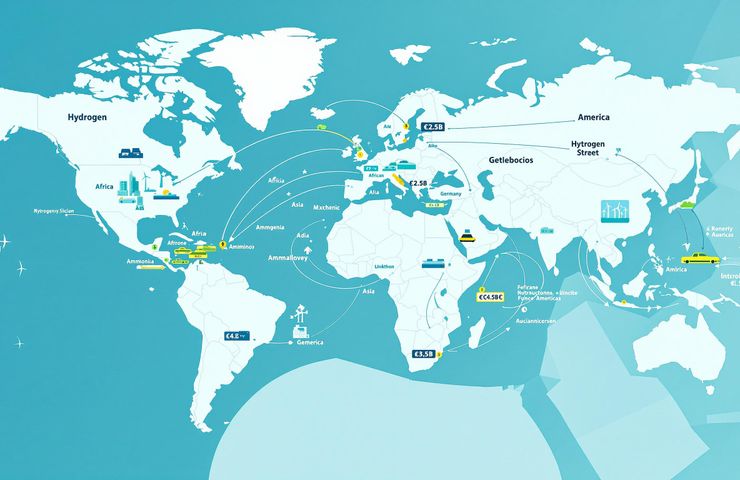
Germany is stepping up its game in the world of clean energy imports, officially opening up the next round of its flagship H2Global auction. Backed by a hefty €2.5 billion (around $2.9 billion) in funding, this round focuses on securing long-term deals for green hydrogen and its key derivatives—that includes ammonia and methanol—sourced from suppliers outside the European Union. The goal? Build a reliable, global supply chain for hydrogen while keeping carbon footprints low.
H2Global Auction Now Open: The Race for Renewable Hydrogen Begins
Applications officially opened on July 4, 2025, and interested players have until September 12 to throw their hats in the ring. Companies from Africa, Asia, North and South America, and Oceania are all eligible—and can apply through either regional or global “lots.” The contracts up for grabs will guarantee supply to Germany, with the government covering part of the cost to help bridge price gaps and encourage adoption.
This whole process is being managed by Hintco—short for Hydrogen Intermediary Network Company. That’s the government-backed team behind the H2Global plan. They use what's called a "double auction mechanism." Here's how it works: Hintco buys hydrogen products from global producers at the lowest prices they can find, then resells them to buyers in Europe at the best price those buyers are willing to pay. The difference—also known as the green premium—is picked up by the German Federal Government and the Netherlands for one of the lots.
Diversifying Hydrogen Supply in a Crowded Market
That €2.5 billion gets split into six separate lots, each with its own budget starting at €484 million and possibly rising to €587 million, depending on funds. This structure supports a wide sourcing strategy—minimizing the risk of leaning too heavily on just one country and opening the door to different forms of transport like liquid hydrogen, compressed gas, or LOHC (Liquid Organic Hydrogen Carrier).
To keep the standards high, only projects with at least 5 MW of input electrolyzer capacity can apply, and they need to meet strict environmental and technical benchmarks. Every hydrogen-based product delivered has to meet EU criteria as a Renewable Fuel of Non-Biological Origin (RFNBO), with full transparency and rigorous carbon tracking baked in.
Why Now? A Post-Crisis Strategy Takes Shape
Germany’s not starting from scratch here—this is round two of H2Global. The first auction launched in late 2023 and helped lay the foundation. But after the 2024 European energy crisis sent prices soaring and raised alarms about supply vulnerabilities, Germany revised its hydrogen strategy to focus more on import diversity and international partnerships.
The fact that the Netherlands is co-funding one lot only strengthens the EU's commitment to building shared, clean hydrogen supply chains. It’s also a big move toward hitting key industrial decarbonization targets—especially for tougher-to-decarbonize sectors like steel, chemicals, and heavy transport that still can't fully rely on batteries or electrification just yet.
Big Incentives for Producers, Big Wins for Europe
For producers looking to get in on the green hydrogen game, the upsides are clear: stable, long-term contracts, demand from a major economy, and financial security. For Germany (and the EU more broadly), it means locking in reliable supply while giving the market a much-needed nudge toward transparency, growth, and competitiveness.
One of the biggest hurdles slowing down global hydrogen production has always been a lack of guaranteed buyers. This auction structure changes that. It gives producers confidence to invest and build while speeding up the creation of critical infrastructure—like terminals, hydrogen pipelines, and storage facilities alike—on both ends of the trade route.
The Flip Side: What to Watch Out For
- Regional imbalances could develop if the bulk of contracts go to countries with the cheapest production costs, potentially sidelining smaller or local EU hydrogen players.
- There are questions around environmental standards—not every producing country has the same regulations in place to guarantee the same clean outcome.
- Supply chain concentration could slowly creep in without diversified procurement, creating new dependencies down the line.
What's Coming Next?
All bids must be submitted online through Hintco’s secure portal, and suppliers have to meet strict commercial and technical criteria. Countries subject to EU sanctions won’t be able to participate at all, staying in line with broader foreign policy requirements.
Many will be watching closely over the next few months to see if this round of H2Global can spark the kind of large-scale, environmentally sound hydrogen trade that experts say we need. In fact, it’s increasingly looked at as a potential blueprint for other countries interested in their own clean hydrogen import frameworks.
Bottom line? If green hydrogen is going to power the next generation of clean industry, it’s going to need more than just local production—it needs a global delivery network to match. Germany’s latest move may be the strongest step yet in building that reality.