Hydrogen Vehicles: Subaru Files Crash-Safety Patent to Protect Tank and Drive Unit
Subaru Corporation filed a patent describing a passive crash-safety packaging that separates hydrogen tank and drive unit movement to enhance tank integrity under collision for future hydrogen fuel-cell vehicles.
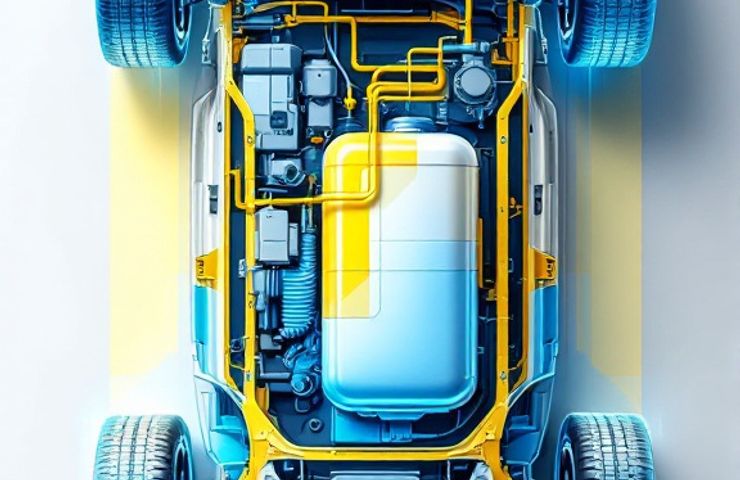
Subaru Corporation in Japan has recently filed for a patent that tackles crash safety in hydrogen fuel-cell vehicles. The innovative design is intended to direct the drive unit upwards while pushing the hydrogen tank downwards during a severe crash, which aims to minimize the chances of ruptures and leaks. This move highlights Subaru's ongoing research and development in hydrogen vehicles even as the spotlight shines heavily on battery-electric vehicles (BEVs).
Patent Concept
Published in late August, Subaru's patent application introduces a unique passive crash-safety design that features intentional "deformation zones." These zones guide the electric motor and hydrogen storage components in different directions during a collision. If the vehicle experiences a hard hit from either the front or back, certain mount structures are designed to bend or collapse predictably. This setup allows the electric drive module to lift while the composite hydrogen tank is pushed down, creating a clear separation between the tank and other mechanical elements. By doing this, Subaru is tackling one of the biggest safety challenges for compressed hydrogen vehicles head-on. In fact, Japan, the EU, and the U.S. have strict regulations that focus on preventing leaks and ensuring tank integrity post-collision—a challenge Subaru's new design aims to meet effectively.
Regulatory Context
Japan has long been a leader in hydrogen vehicle safety regulations, aligning with international standards like the UN/ECE Regulation 134 and those from its own Ministry of Land, Infrastructure, Transport and Tourism. These regulations ensure that onboard high-pressure hydrogen storage remains intact during collisions. Similar standards exist in the U.S. and the EU, requiring detailed testing to confirm leak control after crashes, activation of pressure-relief protocols, and isolation of fuel lines. For automakers, innovations that enhance crash survival and packaging efficiency are crucial for gaining approval for future hydrogen fuel-cell models.
Technical Overview
At the heart of Subaru’s concept is this idea of passive crash-safety packaging. Instead of just adding more structural support, the design strategically uses crushable zones and adjustable motor mounting brackets to absorb impact energy. In severe crash scenarios, simulations show that the bracket folds in a controlled way, raising the drive unit as the lower rail compresses, pushing the composite-wrapped hydrogen tank away from potential impact points. This innovative approach not only protects the tank but also reduces the risk of damaging valves and prevents ignition sources from coming into contact with high-pressure hydrogen lines. Moreover, the system incorporates standard pressure-relief devices and isolation valves to adhere to hydrogen safety protocols.
Historical Context
Subaru Corporation has been exploring alternative propulsion systems for decades, dating back to a fuel-cell prototype displayed at the 1971 Tokyo Motor Show. More recently, they've collaborated with Toyota Motor Corporation on hydrogen-engine and synthetic fuel demonstrations in motorsport and various research initiatives. While their current product lineup focuses mainly on battery-electric and hybrid options, Subaru's commitment to hydrogen R&D remains strong, showcasing earlier fuel-cell prototypes and ongoing hydrogen-combustion tests. This new patent aligns with their history and reflects continuous exploration rather than a sudden shift in strategy, mirroring the wider Japanese industry’s approach of treating hydrogen as a key part of their decarbonization efforts alongside electrification.
Strategic Significance
From a strategic perspective, these patent filings bolster Subaru's intellectual property position while keeping options open for future products. Protecting these innovative packaging designs not only enhances their negotiating power with potential partners but also showcases their expertise in fuel cell technology and hydrogen storage engineering. These aspects can play a crucial role when it comes to securing government funding or forming supply chain partnerships. Although Subaru hasn't committed to launching a commercial hydrogen passenger vehicle, maintaining IP in critical safety areas allows them to keep a technological pathway open. Depending on how market conditions evolve, they could speed up development, leveraging their pre-protected designs.
Market Implications
While hydrogen passenger vehicles remain a niche market, facing challenges like high system costs, limited refueling infrastructure, and prevailing safety concerns, there's growing interest in specific applications. For example, commercial fleets, heavy-duty trucks, and specialty vehicles that require quick refueling and longer ranges are pushing the envelope for hydrogen tech. Innovations that enhance crash safety and leak prevention could also significantly lower certification costs and expedite the market entry of future fuel-cell electric vehicles (FCEVs). For investors, Subaru's advancements in crash-safe packaging may represent a potential revenue stream if other manufacturers decide to adopt similar strategies. Plus, as green hydrogen production ramps up and brings down costs, the overall ownership expenses for fuel-cell vehicles could start to look more appealing. Subaru's safety innovations are essential in tackling critical regulatory challenges.
Subaru’s patent work aligns with efforts from other automakers diving into hydrogen mobility. Toyota has shared its crash-safety concepts for the Mirai fuel-cell sedan, and Hyundai's Nexo is refining its tank and valve systems. Even motorsport ventures involving hydrogen-powered endurance prototypes emphasize the need for safety after a crash. Still, few manufacturers have publicly shared the kind of passive packaging strategies that proactively manage how tanks and motors move in an impact. Subaru's detailed focus on mounting dynamics and movement pathways adds a fresh angle to industry R&D. By filing for this patent early, they’re securing a claim on methods that competitors may eventually need to license if they wish to enhance their own safety features.
Beyond personal vehicles, this patent idea could be adapted for commercial uses, buses, or even hydrogen-based stationary generators where robustness against crashes is critical. Specialty sectors, like off-road machinery, emergency response vehicles, and rail transit, demand resilient storage systems that can withstand vibrations and impacts. By codifying these innovative motion-control strategies in a patent, Subaru is positioning itself to replicate and scale these ideas across various applications. The core concept of separating component movements can be tweaked to accommodate different tank sizes and vehicle designs, likely paving the way for cost efficiencies in protective mounts.
It's worth noting that just because a patent is published doesn’t mean there’s a confirmed production plan in place. Engineers often file patents to safeguard promising concepts and trade secrets, enhancing the company’s overall value, even if those ideas never hit the market. Recently, Subaru has focused its communications on electrification and carbon-neutral fuel experiments without announcing any timelines for an FCEV launch. Until the company shares more about development progress or prototypes, this filing should be seen as a research-driven initiative.
As the hydrogen landscape continues to evolve, safety innovations like Subaru’s crash-safety patent will be pivotal in overcoming barriers to certification and boosting consumer confidence. Whether this design ends up in a future offering or gets licensed out, it emphasizes how critical smart packaging engineering is to make hydrogen vehicles a viable option. For those tracking the hydrogen scene, this patent shows that while battery-electric vehicles might steal the spotlight, the research into hydrogen mobility is still very much alive and kicking behind the scenes.