Hydrogen Production Just Got a Major Upgrade — Without the Electricity
Utility Global and Rockwell Automation have achieved the world’s first commercial hydrogen production using steel plant blast furnace gas—without electricity. This marks a turning point for industrial decarbonization in steel, refining, and chemicals.
A blast furnace gas, a bold idea, and zero electrons
Here's a tough one for the industrial decarbonization crowd: How do you produce clean hydrogen inside a steel plant—without using a single electron—and still slash emissions? Turns out, Utility Global and Rockwell Automation have cracked the code and done something that might just reshape both hydrogen production and the future of heavy industry as we know it.
Back in March 2025, Utility Global dropped some pretty groundbreaking news: they’d pulled off the world’s first commercial hydrogen production using blast furnace gas (BFG) from a steel plant, all through a single-step process that doesn’t use electricity. And this wasn’t some staged demo in a lab—it ran over 3,000 hours straight in an operational steel facility right here in North America. Real plant, real conditions, real results.
Hydrogen without the plug? Here’s how
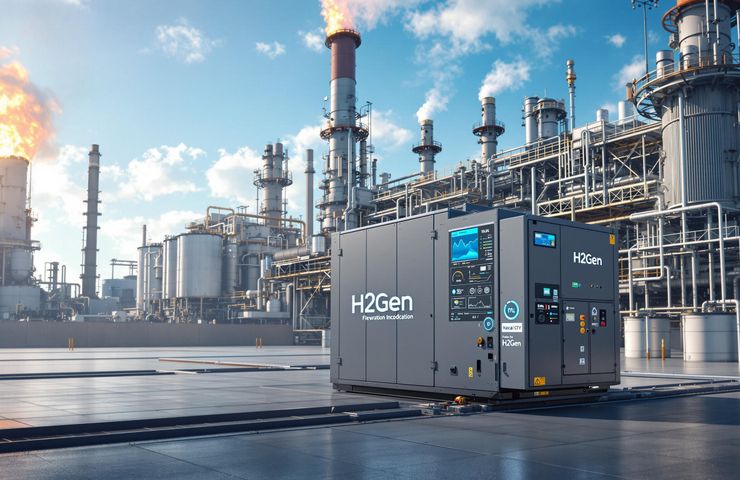
Unlike the usual route for green hydrogen, which leans heavily on water electrolysis powered by renewables (which can get pricey—and scarce), the H2Gen system from Utility Global skips that whole electricity dependency. Instead, it pulls hydrogen from a mix of water and low-value dirty gases—like BFG, the stuff steel mills usually treat as waste—using a unique, zero-electricity electrochemical process they’ve developed in-house.
Even better? H2Gen doesn’t stop at hydrogen. It also pumps out concentrated CO₂ as a byproduct. That’s huge for carbon capture and storage (CCS), because it makes capturing emissions far more practical—and way more cost-effective. It’s a win-win that’s catching the eye of both regulators and facility operators.
Turning steel’s carbon problem into a clean opportunity
The steel industry is one of the world’s biggest CO₂ offenders, coughing up roughly 7–9% of global emissions every year. That’s mostly thanks to blast furnaces, which burn coke to extract iron and release a whole lot of BFG in the process. Until now, most of that gas just gets flared off or burned poorly—total waste.
Utility Global saw it differently. Why not take this waste gas and turn it into something useful—and clean? The real challenge was to do it in a way that didn’t need massive infrastructure changes or cost a fortune. Enter the H2Gen units: compact, modular systems designed to fit right into existing operations. No overhaul required. Just plug into what’s already there and start making hydrogen.
Rockwell Automation: The tech behind the scenes
While Utility Global brings the chemistry, Rockwell Automation brings the control. Their PlantPAx distributed control system keeps the whole operation running like clockwork—tracking assets, collecting live data, and providing seamless plant integration through tools like FactoryTalk View and Historian.
That tech backbone is what makes it easy to scale up quickly—from a single pilot system to full industrial rollout—without having to rip out or rewire existing operations. Simply put, it’s what turns H2Gen from a cool concept into a real-world solution.
Steel’s just the start
Sure, the big splash right now is in steel, but the ripple effects could reach far further. Think chemical plants, refineries, and even oil and gas projects—basically any high-emitting operation where traditional hydrogen infrastructure has struggled to gain a foothold due to high costs and complicated logistics.
By removing electricity from the equation—often a bottleneck for true green hydrogen—H2Gen lowers cost, cuts permitting headaches, and speeds up startup times. Plus, by tapping into industrial waste gases, it flips liabilities into golden opportunities. It’s not just smart technology—it’s smart business.
What makes this different?
Look, people have tried to make hydrogen production cleaner before. But this is the first time anyone’s actually done it at a commercial scale, using real-world blast furnace gas, and managed to do it continuously, efficiently, and—here’s the kicker—without relying on power-hungry electrolysis. That’s what makes this more than just another innovation. It’s a potential playbook for real-world industrial decarbonization.
We’re talking about cleaning up dirty industries without betting it all on unproven tech or waiting decades for perfect renewable infrastructure. It’s practical. It’s scalable. And most importantly, it’s ready right now.
The future’s knocking—and it smells like hydrogen
There’s no question demand for clean hydrogen is heating up. Whether it’s for transportation, ammonia production, or those heavy industries everyone calls “hard to abate,” the race is on for reliable supply—and fast.
This is a big move for Utility Global and Rockwell Automation, giving them a serious leg up as first-movers in a space that’s about to explode. But bigger picture? It’s a major opportunity for steelmakers to turn things around and lead the charge into a zero-carbon future, without stopping the presses.
So maybe the future of clean industry isn’t hiding in next-gen wind farms or high-tech labs. Maybe it’s been floating above blast furnaces all along—just waiting for someone to see the value in the smoke and do something about it.