Hydrogen Production Boosted by Strain-Controlled Pt Single-Atom Catalyst on Crumpled MXene
A new lab study shows that platinum single atoms on crumpled Mo2TiC2Tx MXene achieve overpotentials as low as 24.9 mV at 10 mA cm−2 and a mass activity of 11 859 mA mgPt−1 for alkaline hydrogen evolution, according to PubMed.
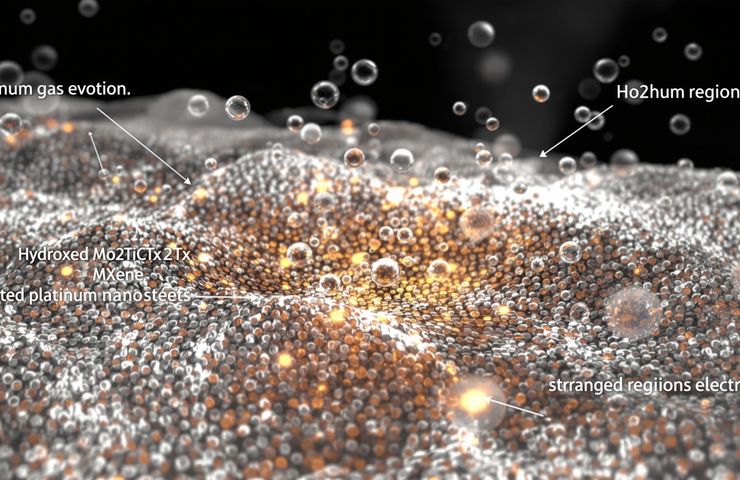
A new experimental study demonstrates that a strain-engineered platinum single-atom catalyst supported on crumpled Mo2TiC2Tx MXene nanosheets delivers remarkably low overpotentials in alkaline hydrogen evolution, according to the indexed abstract on PubMed. The work pairs atom-level platinum dispersion with deliberate mechanical deformation of the support. The result: unusually low overpotentials and high mass activity under laboratory testing conditions.
- Overpotential of 24.9 mV at 10 mA cm−2 and 75.5 mV at 50 mA cm−2, the indexed abstract reports.
- Pt mass activity of 11 859 mA mgPt−1, approximately 178-fold higher than commercial Pt/C, according to PubMed.
- Tafel slope of 31.61 mV dec−1, the abstract states.
- Current density of 3 A cm−2 at 1.98 V and stable operation at 1 000 mA cm−2 for over 500 hours, according to the indexed abstract.
Catalyst Architecture and Preparation
The reported material, denoted Mo2TiC2Tx-PtSA, is built from isolated Pt atoms anchored on mechanically crumpled double-transition-metal MXene nanosheets. According to the indexed abstract, a physical diaphragm-balloon method was used to apply bending and stretching cycles to the Mo2TiC2Tx sheets, generating a long-range strain field without altering surface terminations. That mechanical treatment is central to the paper’s claim: strain, not chemistry, as the tuning knob.
The crumpling modulates local atomic distances and orbital interactions around each Pt site, the study indicates, while the conductive MXene framework maintains high electrical conductivity and abundant binding sites. In short, the support plays both structural and electronic roles. It holds single atoms in place and shapes the immediate electronic environment those atoms experience during reaction.
Mechanism Insight through DFT and Spectroscopy
To probe how strain affects activity, the authors combine in situ spectroscopy experiments with density-functional-theory calculations. In situ spectroscopy experiments and density-functional-theory calculations are presented as supporting evidence that strain accelerates interfacial-water activation and preserves near-optimal hydrogen adsorption, thereby facilitating H2 release, according to the indexed abstract. The computational models estimate reduced energy barriers for water dissociation at strained regions, while operando spectral shifts suggest modified electronic states around Pt atoms under load.
Those pieces together form the mechanistic narrative offered by the team: lower kinetic barriers where the MXene is strained, and hydrogen adsorption energies kept close to ideal at the single-atom sites. The evidence, as presented, links geometric distortion to improved reaction kinetics without changing the elemental composition of the catalyst.
Diaphragm-Balloon Straining Method
The diaphragm-balloon mechanical process places Mo2TiC2Tx nanosheets under controlled deformation, as described in the PubMed record. By avoiding chemical etchants or surface modifiers, the technique isolates strain as the key variable in tuning catalytic behavior. This physical approach retains intrinsic Tx terminations—oxygen, hydroxyl or fluorine groups—while introducing geometric distortions intended to enhance reaction kinetics.
Because the method sidesteps new surface chemistry, the authors emphasize that observed performance changes are attributable to mechanical effects. That framing matters for researchers seeking design levers beyond composition changes: here, shape and stress are the adjustable parameters.
MXene Context and Single-Atom Catalysis
MXenes are conductive, two-dimensional transition-metal carbides or nitrides characterized by surface terminations (Tx) that influence wettability and electronic properties. The double-transition-metal variant Mo2TiC2Tx offers an extended surface area and reactive sites tailored for single-atom anchoring, the study indicates.
A closely related work from Wuhan University of Technology previously reported isolated Pt atoms on flat Mo2TiC2Tx supports requiring 30 mV overpotential at 10 mA cm−2 and stable operation for 100 hours, according to a group-hosted PDF. The new study builds on that foundation by deliberately introducing strain to further optimize water splitting kinetics. Comparison to prior flat supports is used by the authors to argue that strain yields measurable gains in activity and stability.
Commercial Pt/C Benchmark
For reference, commercial Pt/C catalysts in alkaline media typically achieve tens of mA cm−2 at overpotentials above 50 mV. The indexed abstract reports that the crumpled MXene-supported Pt single atoms deliver roughly 178-fold higher mass activity under identical testing conditions, according to PubMed. This comparison highlights the efficiency advantage the authors attribute to atom-level dispersion and engineered support effects.
Lab Relevance and Industrial Context
The reported performance metrics place this catalyst among the most active in alkaline hydrogen evolution demonstrations, the abstract suggests. Industrial electrolyzers often operate above 1 A cm−2, and the study cites stable operation at 3 A cm−2 and 1 000 mA cm−2 over extended durations, according to PubMed. If these results translate to full-cell systems, they could enable significantly lower platinum loadings without sacrificing production rates.
That qualification—“if these results translate”—is important. The study does not report full-cell efficiency, gas purity or large-area electrode fabrication. MXene synthesis commonly involves chemical etching routes that generate waste streams, and scale-up pathways remain unvalidated outside laboratory settings, the broader literature warns. These are practical hurdles that the paper acknowledges only indirectly through comparison and context.
Economic and Environmental Considerations
Atomically dispersed Pt can drastically reduce precious-metal demand per kilogram of hydrogen produced. The indexed abstract’s mass activity figure of 11 859 mA mgPt−1 suggests lower catalyst cost if the approach scales, according to PubMed. Yet catalyst yield, electrode coating uniformity and MXene production cost are not disclosed.
Lifecycle assessments of MXene-based electrodes are not available, and acid or alkaline etching processes often require hazardous chemicals, the literature advises. Future recycling strategies for platinum will be essential to capture both economic value and environmental benefits. Market forecasts for green hydrogen production indicate growing platinum demand, so thrifting methods such as single-atom dispersion warrant further investigation, industry reports show.
Strategic Implications and Outlook
Using mechanical strain as a catalyst-design lever offers a complementary path to chemical composition tuning. By modulating reaction intermediates via support deformation, researchers may unlock new performance regimes without altering elemental makeup. The field will look for independent validation of durability under realistic impurities, full-cell voltage and gas purity tests, and integration into pilot electrolyzer systems.
Conclusion
This study advances the state of alkaline hydrogen evolution catalysts by combining atomically dispersed platinum with a strain-engineered support, according to PubMed. The crumpled Mo2TiC2Tx framework provides a tunable platform that benchmarks high activity at industrially relevant current densities. Translation to commercial electrolyzers will depend on scalable MXene processing, full-cell validation and lifecycle optimization. Future work should verify long-term durability under operating conditions and quantify energy efficiency in complete systems.