Weichai’s WP15 heavy-duty hydrogen engine clears China VI emission certification
Weichai Power’s WP15 hydrogen direct-injection engine has become the first heavy-duty hydrogen internal combustion engine to comply with China VI emission standards after rigorous tests at CATARC’s Tianjin facility.
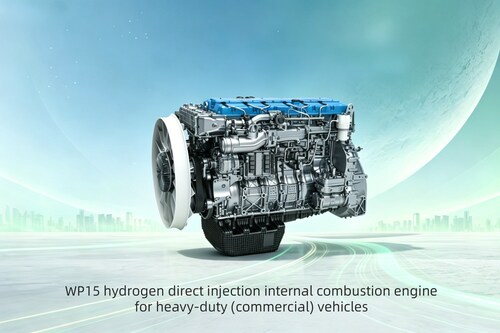
Weichai Power Co., Ltd. just hit a major milestone by getting its WP15 hydrogen direct-injection engine certified under China VI emission standards at the CATARC Automotive Test Center in Tianjin Municipality. This makes the WP15 the first heavy-duty hydrogen internal combustion engine to meet these strict requirements, which is a game-changer for hydrogen vehicles in logistics and industrial use.
So, what’s the deal with China VI? It’s one of the toughest heavy-duty engine standards out there, drastically cutting down allowed nitrogen oxide (NOx) and particulate matter (PM) emissions by over 75% compared to older rules. Plus, it introduces new limits on particle numbers and ammonia, along with real-world driving tests using portable emissions measurement systems. Since 2025, this standard has even included hydrogen internal combustion engines, and the WP15 is leading the charge in this new framework.
During testing, CATARC ran a series of thorough assessments, checking everything from the World Harmonized Stationary Cycle to on-road evaluations. They measured gaseous pollutants and particle counts, ensuring the engine held up in various conditions like cold starts and full-load runs, all while keeping within those strict NOx, PM, and ammonia limits. It's a pretty rigorous testing process that guarantees the WP15 performs well when it counts.
Innovative spark ignition and direct injection
The WP15 is a hefty 14.6-liter spark-ignited engine designed purely for hydrogen. Unlike traditional diesel engines, it injects hydrogen straight into the combustion chamber, igniting it with a spark plug. This direct-injection method allows for pinpoint control over fuel delivery and timing, resulting in ultra-lean combustion—boosting thermal efficiency and cutting down NOx emissions. Plus, the engine features high-efficiency turbocharging to keep power up even with lean mixtures, and it has a specially designed aftertreatment system to handle hydrogen by-products without adding unnecessary complexity.
Component strategy and manufacturing leverage
Weichai's strategy is pretty savvy—they reuse more than 90% of the parts from conventional engines, including structural castings and crankshafts. The only new components are the fuel rails, injectors, and ignition modules; everything else is adapted from existing technologies. This means fewer custom parts, which simplifies the certification process and makes it easier for maintenance teams familiar with diesel engines to jump on board.
When it comes to performance, Weichai claims a peak thermal efficiency of 46.8%, with output reaching around 600 horsepower and 2800 Nm of torque. This is great news for fleet operators since it matches many high-end diesel models while producing zero CO2 when running on green or low-carbon hydrogen. Plus, the WP15 can handle a range of hydrogen purities, making it more flexible compared to some fuel cell systems.
Strategic implications for heavy transport
This certification really puts Weichai Power front and center in the hydrogen energy news scene, especially as most of the buzz has been around fuel cells and battery-electric options. With governments and businesses stepping up investments in green hydrogen production and infrastructure, having an internal combustion engine like the WP15 can make it easier for early adopters to transition and help spread hydrogen vehicles more widely.
Hydrogen internal combustion engines could play a big role in various sectors, from long-haul trucking to logistics in the steel industry and even power generation, especially where demands are high. Industry players are looking into how these engines can work alongside batteries and fuel cells, wondering if a mix of technologies might just offer the best of both worlds in terms of cost and performance.
Bridging to fuel cells and electric trucks
While many folks are excited about hydrogen fuel cell technology and its potential in heavy trucks, the WP15 shows there’s still room for spark-ignited combustion in a well-rounded hydrogen strategy. Sure, fuel cells may offer higher efficiency for some applications, but they come with pricier catalysts and strict hydrogen purity requirements. The WP15, on the other hand, has a simpler aftertreatment system and is more tolerant of different hydrogen storage conditions—making it a solid option while hydrogen refueling infrastructures are still being developed.
Global implications and export potential
With heavy-duty trucks now operating under the China VI standards, this certification also opens up export opportunities to regions that recognize similar benchmarks. Countries in Europe, parts of Asia, and Latin America that align with China VI could potentially import vehicles featuring the WP15, giving Weichai a head start. Their existing partnership with Sinotruk hints at exciting prospects for integrating this engine into heavy-duty truck lines overseas.
Of course, scaling up hydrogen infrastructure will be crucial. Building more refueling stations, establishing reliable hydrogen storage, and developing efficient supply chains for clean hydrogen production will be key to how fast fleets adopt hydrogen vehicles. Industry players are already exploring modular storage tanks, mobile refueling options, and on-site electrolyzers tailored to fit the demands of long-haul routes.
For early adopters, total cost of ownership is often top of mind. Fuel costs and driver wages are major considerations. While diesel engines still hold a cost advantage for now, the hydrogen fuel news points towards a future where prices could drop as electrolysis projects ramp up. Plus, the shared parts strategy of the WP15 could lead to lower maintenance costs compared to tailor-made fuel-cell drivetrains. If hydrogen production prices come down as expected, operators might find themselves closing the gap with diesel over a vehicle's lifespan.
As Weichai gears up for mass production, they’re busy refining supply agreements, setting prices, and working with regulators on monitoring requirements. Getting real-world data on fuel consumption, maintenance needs, and durability under different working conditions will be essential to gain broader acceptance among fleets. They’ve mentioned that pilot fleets will roll out once the commercial version is ready to go.
This certification from the CATARC Automotive Test Center in Tianjin is a big moment in the hydrogen energy news landscape. It shows a clear path for hydrogen internal combustion engines to meet even the toughest emission standards. As green hydrogen production expands and infrastructure improves, engines like the WP15 could offer a viable alternative or complement to fuel cells—helping to decarbonize heavy transport and ushering in a new era of clean mobility.