PowerCell and DLR Launch Methanol-to-Power Test in Kiel
PowerCell Sweden AB secured a SEK 21 million order from DLR to install an integrated methanol-to-power fuel cell system at Kiel’s maritime test facility, advancing collaborative hydrogen fuel cell innovation.
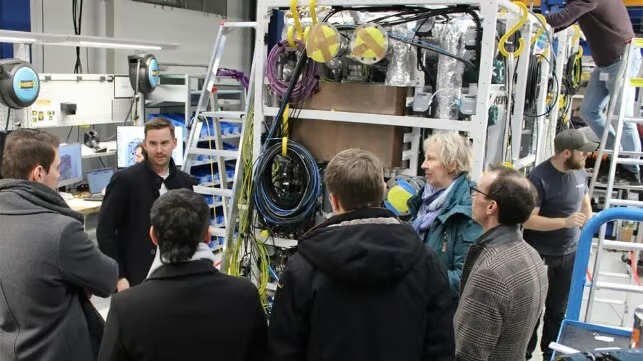
Kiel, a key player on Germany’s Baltic coast, is really making headlines in the clean hydrogen news scene, shining a light on what can happen when industry partners up with research. Earlier this year, the city’s well-known maritime test facility unveiled a cutting-edge system worth SEK 21 million—a fully integrated methanol-to-power platform that’s not only innovative but also a practical demonstration of advanced hydrogen production methods and hydrogen infrastructure. Developed by PowerCell Sweden AB and the German Aerospace Center (DLR), this system pairs two Marine System 225 PEM fuel cell units with advanced methanol reformers and hydrogen storage to churn out electricity and heat—all while relying on just water and keeping CO₂ emissions to a minimum.
A New Chapter in Maritime Decarbonization
This installation is truly a game-changer as we work towards decarbonizing large vessels. During testing at DLR’s Kiel facility, the integrated system will run through real-life scenarios, mimicking everything from steady cruising to dynamic port operations. Each fuel cell unit pumps out 225 kW, so this setup can handle auxiliary and peak power needs typically met by diesel generators, slashing local emissions of soot, NOₓ, and CO₂ by up to an astonishing 99% compared to the old-school systems. For the first time, researchers will capture detailed performance data on a methanol-to-power arrangement under real maritime conditions, setting the stage for broader applications in cruise ships, ferries, and support vessels.
The groundwork for this demonstration was laid at DLR’s megawatt-scale BALIS test center, which has checked fuel cell stack outputs of over 1.5 MW. By linking together the Marine System 225 units, Kiel’s setup builds upon previous test stands while incorporating cutting-edge diagnostics. Engineers will keep tabs on voltage stability during changing loads, how quickly the system starts up, and how it reacts to rapid power changes—scenarios that emulate emergency thrust adjustments or dynamic positioning. This level of detail means the data collected can help shipyards, classification societies, and equipment manufacturers develop better strategies for system reliability and maintenance.
Collaborative Innovation Between Industry and Research
This project’s success hinges on a diverse group of partners working together. PowerCell Sweden AB brought its tried-and-true M2Power platform to the mix, adapting the architecture specifically for maritime research. Technology provider MReformer delivered the methanol reforming skid, which allows for on-site conversion of liquid methanol into a hydrogen-rich gas. Meanwhile, teams at DLR’s Institute of Maritime Energy Systems and Institute of Engineering Thermodynamics are running the test stand, drawing from insights gained from projects like NAUTILUS, HySeas III, and PEMScale 1.5. This initiative is part of the ambitious zero4cruise project, which has a budget of around €18.7 million to develop powerful methanol fuel cell systems for both new and retrofitted cruise vessels.
Researchers at the Institute of Engineering Thermodynamics have been fine-tuning high-temperature PEM stacks, enhancing membrane materials and catalysts to handle trace amounts of CO in reformate streams. On the flip side, the Institute of Maritime Energy Systems has been conducting long-term endurance tests on a 500 kW demonstrator under ongoing, cruise-like conditions. By pooling their resources and expertise, this consortium is speeding up the journey from lab tests to actual sea trials, solidifying Europe’s position in the global quest for sustainable marine propulsion.
From Methanol to On-Demand Power
The core of this installation is all about the smooth transition from methanol storage to generating electricity. Liquid methanol is fed into reformers, where it mixes with steam and flows over catalysts to create a hydrogen-rich gas stream through steam reforming reactions. After a short buffer stage to stabilize pressure and ensure purity, the hydrogen moves into two Marine System 225 PEM fuel cell stacks. Operating at 60–80 °C, these units convert hydrogen and oxygen from the air into electricity, heat, and deionized water. An integrated control system adjusts fuel and process parameters in real time to match power output to various simulated vessel loads. Researchers are diving deep into key metrics like dynamic response, stack durability, energy efficiency, and maintenance needs—info that’s crucial for scaling up hydrogen fuel cell systems in commercial shipping.
Technicians will also keep an eye on CO₂ levels, paving the way for future carbon capture integration. The steam reformers operate at about 250–300 °C, employing copper-zinc catalysts to efficiently drive reactions, hitting conversion rates of over 85%. With a hydrogen buffer tank that can manage brief surges of up to 10% of maximum flow, they can smooth out production peaks without stressing the reformer. By recapturing heat from the exothermic reforming step, the system can recover up to 70% of thermal energy for on-board heating or even preheating incoming methanol—boosting overall efficiency to over 60%, which is a significant jump from traditional marine generators.
Charting the Future of Hydrogen Infrastructure
DLR’s Kiel facility isn’t just a lab; it’s a glimpse into the emerging landscape of hydrogen infrastructure for maritime use. By focusing on bunkering scenarios, refueling protocols, and hybrid energy management, the test stand will help refine best practices for safe, efficient operations aboard vessels. Insights from this research will shape standards for fuel storage and handling of both methanol and hydrogen, as well as digital control strategies that integrate fuel cells with batteries or diesel generators. By validating methanol as a practical energy carrier, this project addresses the storage challenges associated with compressed hydrogen tanks and sets the scene for the production of green methanol from renewable hydrogen and captured CO₂—closing the loop on sustainable green hydrogen production.
As part of the EU’s Fit for 55 and FuelEU Maritime initiatives, this project equips regulators with hard data needed to establish realistic emissions thresholds and safety guidelines. The takeaways from this endeavor could speed up the development of hydrogen refueling stations in Northern Europe’s busy ports, establishing routes that support both cargo and passenger ships. Through these efforts, Kiel is playing a significant role in defining how ports, shipowners, and fuel providers can work together to build a robust, low-carbon shipping network.
Scaling Up and Replicating Success
While the Kiel demonstration showcases a combined 450 kW of fuel cell capacity, the insights gained will resonate far and wide. PowerCell has already bagged a SEK 150 million contract for its 2 MW M2Power 250 system at a major European shipyard, and this research backs up the platform under rigorous testing conditions. As operators strive to meet tightening IMO and EU decarbonization goals, the ability to roll out modular methanol-to-power systems will give them a serious competitive edge.
But it doesn’t stop at shipping. The M2Power architecture also holds promise for off-road vehicles, railway auxiliaries, and stationary backup power—think green data centers and remote grids. If green methanol production can step up to meet rising demand, lifecycle emissions could fall by more than 80% compared to heavy fuel oil. With policy support, clean hydrogen offtake agreements, and advancing financing options, this innovation hub in Kiel serves as a roadmap for replicating success worldwide—showing that teamwork, innovative spirit, and ambition are key to charting a course towards a net-zero maritime future.
With industry leaders, research trailblazers, and government agencies all pulling in the same direction, Kiel’s test facility is turning into a beacon in global hydrogen energy news. The momentum building here is set to flow out to shipyards, refueling networks, and classification societies, hastening the shift to low-carbon fuels. By transforming methanol into on-demand power, this initiative is setting a fresh course for sustainable marine transport—demonstrating that innovation, collaboration, and a shared purpose can lead us to a cleaner, more resilient future.