Green Hydrogen News: L&T’s Refinery Contract Anchors Production as Thermax Advances Electrolysis Pilots
L&T has anchored its green hydrogen strategy with domestic electrolyser commissioning at Hazira and Kandla and a 10,000 tpa contract with IndianOil’s Panipat refinery, while Thermax advances licensed alkaline systems and a 720 kW SOEC pilot. Investors should focus on commissioning milestones, utilisation rates and separate hydrogen financial disclosures to gauge execution risk.
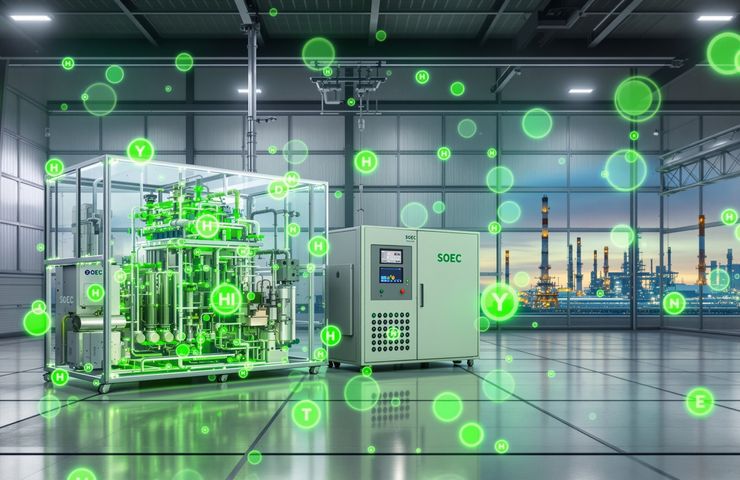
Larsen & Toubro has secured a near-term foothold in India’s green hydrogen sector by pairing domestic electrolyser manufacture with a build-own-operate refinery offtake. At the same time, Thermax Limited is pursuing both alkaline and high-temperature electrolysis routes, according to company statements and government sources.
Visible Demand Anchor
L&T Energy GreenTech, a wholly owned subsidiary of Larsen & Toubro, won a tender to supply 10,000 tonnes per year of green hydrogen to IndianOil’s Panipat refinery under a 25-year contract, industry filings show. IndianOil states that commissioning is planned by late 2027 and that the discovered procurement price is ₹397 per kilogram including GST. The contract gives a clear offtake for hydrogen produced by high-pressure alkaline electrolysers from L&T Electrolysers, and it offers investors a tangible demand anchor amid wide policy ambitions.
The group has already commissioned a domestically manufactured 1 MW electrolyser at its Hazira site, and the Press Information Bureau reports that a 1 MW demonstration plant at Kandla Port now produces around 140 tonnes annually. L&T says its Hazira facility is a giga-scale expandable plant using technology licensed from France-based McPhy Energy. The company adds the site supports local testing and has indigenised over 85% of its supply chain, including a 4 MW zero-gap stack design that the company indicates boosts efficiency.
Thermax’s Dual Technology Path
Last year, Thermax struck a strategic partnership with Norway’s HydrogenPro to gain exclusive Indian rights for supply, installation, commissioning and after-sales service of alkaline electrolyser systems based on HydrogenPro stacks. Under that arrangement, HydrogenPro provides core modules while Thermax engineers and manufactures the balance-of-plant locally. This model keeps core electrochemical modules in the hands of the licensor while placing system integration and site engineering with a local player.
Alongside the HydrogenPro tie-up, Thermax holds a non-exclusive global licensing agreement with the UK’s Ceres Power for solid oxide electrolyser cell (SOEC) technology. The company indicates it is commissioning a 720 kW pilot plant that uses steam and electricity at high temperature to reduce net electrical consumption when industrial waste heat is available. But pilot-scale performance, long-term durability and customer validation remain critical next steps before SOEC can become a significant earnings driver.
Policy Framework vs Commissioning
India’s National Green Hydrogen Mission carries a policy outlay of ₹19,744 crore, including ₹17,490 crore for electrolyser manufacturing and production incentives, MNRE’s official material states. The mission targets 5 million tonnes per year of green hydrogen production by 2030 supported by roughly 125 GW of renewable capacity, aiming to make India a global hub.
To date, awards total 3 GW per year of electrolyser manufacturing capacity across about 15 companies, and 8.62 MTPA of green-hydrogen production capacity has been granted to 18 companies. Yet the Press Information Bureau reports only around 8,000 tonnes per year of commissioned capacity had been achieved through early 2026. That disparity highlights the gap between announced targets and operational output, and it puts a spotlight on utilisation, power reliability, water availability and supply-chain health as decisive factors for delivery.
Electrolysis Techniques and Plant Economics
High-pressure alkaline electrolysis, the approach used by L&T Electrolysers and in the HydrogenPro partnership, remains the most mature industrial route. In such systems, a potassium-hydroxide electrolyte and diaphragm separate hydrogen and oxygen. Zero-gap stack configurations can reduce resistance and improve energy efficiency, L&T indicates.
By contrast, SOEC technology licensed from Ceres Power operates at elevated temperatures—Thermax expects around 500–600°C—and uses industrial steam or waste heat to lower electrical energy input. While SOEC may offer higher efficiency under ideal thermal integration, it brings greater materials complexity, start-up constraints and unproven long-term durability at scale, Thermmax cautions.
Decoupling Policy and Profitability
Generous policy support does not automatically translate into profitable projects. MNRE predicts more than ₹8 lakh crore of catalysed investment, but those projections are prospective. The broader segment results from parent companies like Larsen & Toubro and Thermax do not itemise hydrogen revenues, margins or cash flow, and each diversified business continues to rely heavily on non-hydrogen orders.
Investors therefore must examine project-level economics. Warranty performance, recurring service revenues and utilisation rates will determine whether awarded capacity becomes a sustainable cash-generating asset. Only by scrutinising these line items can market participants separate headline capacity numbers from profitable operation.
Balance of Plant in Focus
Both L&T and Thermax emphasise the role of local engineering for balance-of-plant systems, which include water purification, power conversion, cooling, gas separation and compression. Thermax highlights its industrial utilities engineering expertise, while L&T Electrolysers points to bespoke testing facilities at Hazira. Design choices for these supporting systems materially affect uptime, operating cost and overall plant efficiency.
Early Deployment Highlights
The 1 MW demonstration at Kandla Port is reported by the Press Information Bureau to produce around 140 tonnes of green hydrogen annually, using electrolysers manufactured by L&T. Although this output is a small fraction of the capacity that has been awarded, the Kandla project and the Hazira commissioning serve as practical proof points that domestic manufacturing can supply initial industrial applications, particularly in port decarbonisation and refinery supply chains.
For investors, the immediate signals to watch are commissioning milestones, stack durability, recurring service revenue and hydrogen-specific financial disclosures. Larsen & Toubro provides nearer-term visibility through Hazira, Kandla and its Panipat contract, yet profitability on these ventures remains undisclosed. Thermax brings established engineering skills for alkaline systems and the potential efficiency gains of SOEC, but its pilot-stage activity adds execution risk until commercial validation is achieved.
Looking ahead, the industry’s progress will turn on a few measurable transitions: delivery against offtake contracts, the shift from pilot to commercial operations, and consistent performance from stacks and balance-of-plant equipment. Those milestones will be the clearest indicators of execution risk and of any viable path toward sustainable industrial decarbonization.