Fraunhofer IMM Unveils 25 kW Diesel Reformer for Maritime Fuel Cells
Fraunhofer IMM has built a 25 kW maritime diesel reformer under the ZIM-supported DIMARIT project to convert onboard diesel into hydrogen-rich gas for fuel cells, with a public demo scheduled in Hamburg.
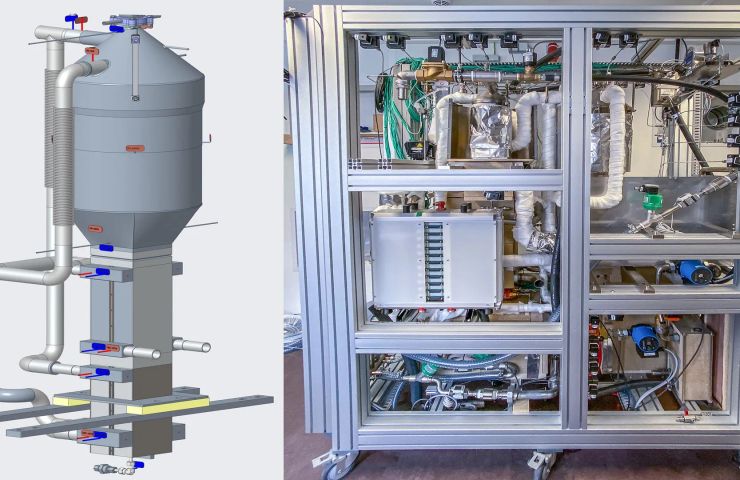
Fraunhofer Institute for Microengineering and Microsystems IMM in Mainz has developed a 25 kW diesel reformer for maritime power generation, according to the institute’s press material, and plans to demonstrate the system at the upcoming Hydrogen Technology World Expo in Hamburg later this year. The device targets auxiliary power duties on ships where space for large fuel tanks or hydrogen cylinders is limited. Fraunhofer IMM’s announcement frames the work as a demonstration-ready prototype rather than a commercial product at scale.
Converting Onboard Diesel into Hydrogen-Rich Gas
Fraunhofer IMM explains that the reactor vaporizes liquid diesel, mixes it with controlled air and steam, and heats it under autothermal conditions. In that sequence, catalysts then break down hydrocarbon chains into a reformate gas containing hydrogen, carbon monoxide, carbon dioxide and water vapor. The design avoids carrying compressed hydrogen by transforming fuel already on board into a hydrogen-rich stream for fuel-cell use. It is a different approach from installing separate hydrogen tanks: the ship’s existing liquid-fuel logistics remain the primary supply pathway.
Why Purification Matters
The raw reformate cannot be fed directly into a proton-exchange-membrane (PEM) fuel cell because carbon monoxide and other impurities can poison the cell’s catalysts. Fraunhofer IMM says its system includes compact catalytic purification stages—using water-gas-shift and preferential-oxidation reactors integrated with plate-heat-exchanger structures—to reduce contaminants before the gas reaches the fuel-cell stack. Those purification steps are essential if a PEM stack is to retain performance and lifetime comparable to stacks run on clean hydrogen.
Modular System Integration
Beyond chemistry, the institute highlights process coordination and thermal management as central to system reliability. Heat generated during endothermic and exothermic reactions is recovered and redistributed to maintain optimal reactor temperatures. Fraunhofer IMM also emphasizes vibration-resistant components and marine-grade materials to withstand movement, corrosion and salt-air exposure. Taken together, these elements aim to keep the reformer operational in a seagoing environment where thermal swings and mechanical shock are routine.
Part of the ZIM-Backed DIMARIT Project
The development is carried out under DIMARIT, a cooperative research initiative funded by Germany’s Central Innovation Programme for SMEs (ZIM), Fraunhofer IMM confirms. DIMARIT targets a 25 kW capacity for auxiliary or specialized marine applications, although the institute notes the full project consortium and funding details remain undisclosed. The ZIM backing identifies the work as publicly funded cooperative R&D rather than a solely in-house commercial programme.
Logistics and Operational Trade-Offs
By tapping existing liquid-fuel infrastructure, ship operators could avoid installing compressed or liquefied hydrogen tanks, Fraunhofer IMM suggests. This flexibility may appeal to yacht owners, port tugs, military surveillance vessels or research platforms where quiet, low-pollutant auxiliary power is valued. At the same time, the institute cautions that reforming conventional diesel still produces carbon-containing exhaust and incurs additional energy losses compared with direct combustion. Operators therefore face trade-offs: lower local emissions and quieter operation versus downstream CO₂ and a thermodynamic penalty.
History of Diesel-Based Fuel Processing
Fuel-processor research dates back decades. Technical literature from the early 2000s—such as the DESIRE project supported by European partners and ECN—demonstrated a 25 kW marine diesel fuel processor coupled to a PEM fuel cell, achieving high fuel-processor efficiency under controlled conditions. Fraunhofer IMM positions its work as a modern, microstructured update rather than a first demonstration of diesel reforming. The institute frames the contribution as an iteration on established concepts, with focus on compactness and materials suited to maritime deployment.
Performance Questions Remain
Key metrics—electrical efficiency, transient response, startup time, sulfur tolerance, durability under shock and vibration—have not yet been published. Fraunhofer IMM says live sea trials and classification-rule approval are pending. Costs, maintenance intervals and lifecycle greenhouse-gas impact also await independent assessment before the approach can be compared with batteries, direct hydrogen, methanol or efficient combustion generators. In short, technical demonstration is only the next step; independent validation and regulatory clearance will determine whether the concept can move beyond prototypes.
Environmental and Regulatory Context
While onboard reforming may cut local nitrogen-oxide emissions compared with a diesel generator, it does not eliminate CO₂ when fed with conventional diesel, Fraunhofer IMM notes. Synthetic diesel could offer lower lifecycle emissions if produced via a low-carbon pathway, but the institute clarifies that climate neutrality depends on upstream fuel production. Separately, the International Maritime Organization has issued interim safety guidelines covering fuel-cell installations and reformed fuels, indicating a regulatory framework is emerging. These guidelines, however, remain interim and are one of several compliance factors that project developers must consider.
Looking Ahead
The upcoming public demonstration in Hamburg will reveal how the integrated system performs under exhibition conditions. Beyond that, Fraunhofer IMM plans to refine system scalability—modular upgrades might reach 100 kW in future iterations, the institute suggests. Whether the diesel reformer finds a niche in auxiliary ship power will hinge on certification, performance under real-world conditions and total cost of ownership compared with alternative zero-emission or low-emission technologies. Certification and operational data will be decisive: until then, the concept remains a promising but unproven option for specific maritime roles.
As hydrogen infrastructure and green fuels advance, on-board reforming of liquid hydrocarbons remains a pragmatic bridge technology. It adapts fuel-cell systems to established supply chains, offering quieter and potentially cleaner power where full decarbonization may only come later. The approach does not claim to be a final solution; rather, it presents a transition path that leverages existing logistics while new fuels and refuelling networks develop.