Crystal Symmetry Governs Quantum Tunneling for Tunable Solid-State Hydrogen Storage in Vanadium
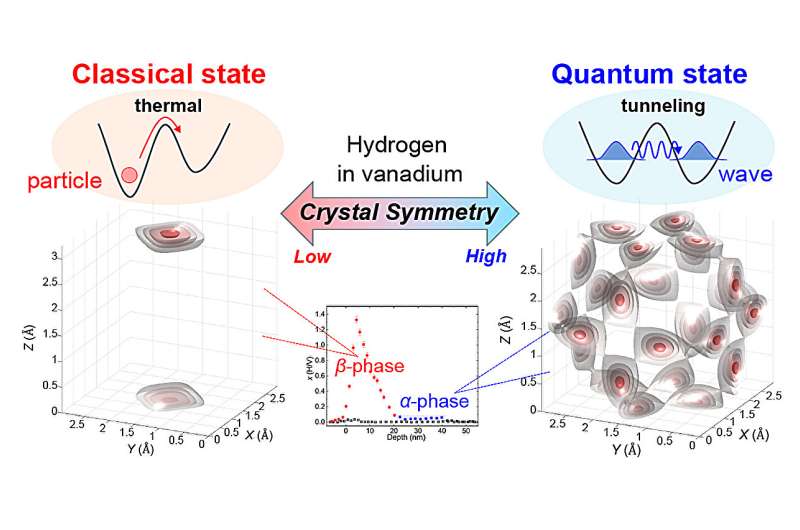
A team at the Institute of Industrial Science, University of Tokyo, has shown that crystal symmetry in vanadium acts as a switch for hydrogen’s quantum tunneling versus classical hopping, offering a new design rule for solid-state hydrogen storage materials.
When it comes to hydrogen as a zero-emission energy carrier, a big part of the puzzle is figuring out how to store it safely while still allowing for quick charging and discharging. Researchers from the Institute of Industrial Science at the University of Tokyo have discovered something pretty intriguing: a basic property called crystal symmetry can actually toggle how hydrogen atoms behave in vanadium metal. This breakthrough could pave the way for better solid-state hydrogen storage—an essential piece of the puzzle for our future hydrogen infrastructure.
Quantum vs Classical Transport: The Core Discovery
The team at IIS, led by research associate Takahiro Ozawa and professor Katsuyuki Fukutani, dug deep into how hydrogen behaves in vanadium lattices. By blending precise diffusion measurements with quantum mechanical calculations, they explored what happens when hydrogen is introduced to vanadium. At low concentrations, the vanadium lattice maintains a high level of symmetry, allowing hydrogen atoms to act like delocalized waves that can tunnel through barriers effortlessly. But as hydrogen concentration increases, the lattice gets distorted, which disrupts this symmetry and makes hydrogen revert to classical, thermally activated hopping. Instead of tunneling through barriers, they're now climbing over them—talk about a dramatic change!
Experimental and Computational Approach
To put their theories to the test, the researchers carefully introduced hydrogen gas to vanadium samples while controlling the pressures and temperatures. They observed how hydrogen occupied different interstitial sites within the lattice—specifically, the tetrahedral and octahedral spots. Using thermal desorption analysis and mass spectrometry, they tracked how quickly hydrogen moved around. Parallel density functional theory (DFT) calculations then came into play to model the electronic structure of vanadium with varying levels of hydrogen, quantifying energy barriers and tunneling probabilities. By linking their experimental findings with the theoretical calculations, the team figured out that crystal symmetry is the main factor influencing how hydrogen gets transported in these materials.
Design Implications for Solid-State Storage
This focus on mechanics gives materials engineers a fresh perspective. For quick refueling in applications like fuel cell vehicles or large-scale energy storage, designers can work to maintain high symmetry in vanadium-based alloys or nanostructures. This approach maximizes tunneling-enabled diffusion even at moderate temperatures. On the flip side, if the goal is long-term stationary storage or ensuring safety in critical modules, they can deliberately introduce lattice distortions by adding elements like titanium or chromium, or using strain, which suppresses tunneling and slows down hydrogen’s release.
Positioning Within Vanadium Hydride Research
Vanadium and its hydrides have been the subject of study for years, known for their impressive volumetric capacity and rapid kinetics. Research has shown that group VB metals readily dissolve hydrogen and create various hydride phases with different site occupancies. While earlier investigations noted quantum tunneling in vanadium diffusion, they often dismissed these effects as temperature anomalies. The IIS team’s new findings reframe these effects through the lens of symmetry, unifying decades of fragmented observations under a coherent theory.
Strategic Impact on Hydrogen Infrastructure
Solid-state hydrogen storage is crucial in the green hydrogen production landscape. While compressed and liquefied hydrogen storage can be pricey—requiring high-pressure vessels or intricate cryogenics—using metal hydrides can offer safer and more compact alternatives. By clarifying how to optimize hydrogen mobility through symmetry, this research could speed up the production of vanadium-based storage tanks for hydrogen refueling stations or modular storage units at renewable energy sites. It might also help set standards for maximum loading and acceptable alloy compositions to keep up with new safety regulations.
Looking ahead, the insights from IIS marry fundamental science with practical engineering. They've laid down a quantifiable design rule: controlling crystal symmetry can help maximize hydrogen diffusion. As hydrogen refueling networks grow and the green hydrogen production sector expands, these kinds of insights will become invaluable, ensuring our storage technologies keep pace without sacrificing safety or flexibilit