TURN2X’s Power-to-Gas Plant in Miajadas Taps Green Hydrogen for Synthetic Methane with EU Hydrogen Bank Support
TURN2X’s Miajadas power-to-gas facility produces synthetic methane from green hydrogen and CO₂ and secured support from the EU Hydrogen Bank.
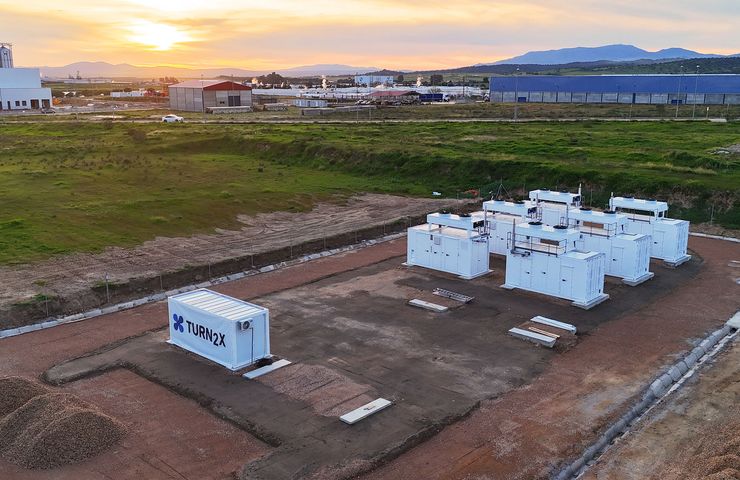
TURN2X GmbH is operating a power-to-gas demonstration facility at the Primero de Mayo industrial estate in Miajadas, Extremadura, converting green hydrogen and carbon dioxide into synthetic methane compatible with existing gas networks, El Confidencial reports. The installation is presented as a testbed for feeding renewable gas into pipelines originally designed for fossil supplies. It sits inside an industrial cluster and links electrolysis, methanation and grid interfaces in a single site.
Project Overview
The Miajadas plant uses a water electrolyser powered by certified renewable electricity to split water into hydrogen and oxygen; the hydrogen then reacts with CO₂ in a Sabatier methanation reactor to form CH₄ and water, according to TURN2X. Company material indicates the first commercial unit was inaugurated in 2024 and features a 1 MW electrolyser capacity. That configuration is intended to show how renewable electricity can be converted into a pipeline-ready gaseous fuel.
TURN2X operated a pilot methanation plant in Brandenburg that injected renewable gas into the German network from 2019, the company says, positioning Miajadas as its first commercial-scale demonstration in Spain. The Brandenburg experience provides an operational precedent, the company notes, though the Spanish site marks a step up in scale and in integration with local supply chains.
Situated in a municipality of roughly 9,400 residents according to the National Statistics Institute, the site benefits from local solar resources and established gas distribution infrastructure, facilitating integration of renewable natural gas. Proximity to grid assets reduces the complexity of connecting test outputs to a functioning distribution network.
The region’s economy, rooted in agriculture and agro-industry, provides access to biogenic CO₂ streams from ethanol producers, potentially lowering feedstock transport costs, analysts say. Local sourcing of CO₂ is cited as an advantage for demonstration projects that require a traceable carbon input.
In 2026, the regional environmental authority approved a resolution for an R&D modification to add a 1 MW prototype reactor and a laboratory reactor for limited campaigns; test methane from this system will be burned in flares rather than injected, the resolution states. The decision imposes operational limits intended to keep demonstration outputs off the commercial grid while tests are carried out.
The resolution specifies that the prototype reactor will operate for ten days at ten hours per day between July 2026 and April 2027, while the laboratory reactor will conduct four 30-hour campaigns, the resolution details. Those windows are narrow. They are framed as targeted trials rather than continuous commercial operation.
Technology and Performance
The facility illustrates a power-to-gas process: electrolysis produces hydrogen, which is combined with CO₂ over a catalyst in a Sabatier methanation reactor to yield methane (CH₄) and water, according to company documentation. The process chain also includes gas-cleaning stages and compression so that the final product can meet pipeline specifications.
TURN2X deploys a modular honeycomb reactor design derived from research associated with the Karlsruhe Institute of Technology, the company says; this geometry enhances heat transfer and supports flexible load changes compared to traditional packed-bed reactors. The honeycomb form factor is presented as enabling quicker thermal management and operational flexibility.
TURN2X traces its reactor design to honeycomb methanation research at KIT, co-founder Dr. Dominik Schollenberger says; however, KIT is not a formal commercial partner in the Miajadas project. That distinction clarifies the research lineage without implying an institutional commercial tie.
The International Energy Agency estimates that methanation reaction steps can reach around 77 % efficiency, although Miajadas-specific performance data have not been independently published, according to public sources. Key components such as gas purification, compression and digital certification systems form part of the overall chain, TURN2X indicates. In short: reaction efficiency is only one element of the full, system-level performance picture.
Grid Injection Tests
El Confidencial reports that the plant has successfully injected synthetic methane into the Gas Extremadura distribution network, marking a milestone for renewable gas integration. The move demonstrates technical compatibility at least in a limited trial context.
Gas Extremadura has not published detailed acceptance data, leaving the volume, duration and continuity of injections unverified. Independent confirmation of throughput and persistence therefore remains outstanding.
Network compatibility tests covered pressure, metering and safety parameters required for CH₄ interchangeability, local regulators say, although public reports do not specify test outcomes. The demonstration aimed to confirm that synthetic methane meets existing quality standards without requiring major pipeline modifications.
EU Hydrogen Bank Auction Selection
A related extension project coordinated by TURN2X Asset Co II Extremadura SL was selected under the third European Hydrogen Bank auction, according to the European Commission. Official auction documents list a bid for 9 MWe of electrolyser capacity, 6,390 tonnes of hydrogen production over ten years, and an expected avoidance of 43.71 kilotonnes of CO₂-equivalent emissions. The project would receive a premium of €0.62 per kilogram of hydrogen, pending final signature of the grant agreement.
The Commission states that the third auction allocated over €1 billion in support across nine projects in seven European Economic Area countries, collectively covering nearly 1.1 GW of electrolyser capacity aimed at certified renewable hydrogen production. The Commission indicated that grant agreements are expected to be signed by the final quarter of 2026, though the T2X project’s financial close remains pending those procedures. Financial close will depend on finalising grant paperwork and satisfying the conditions set out in the award.
Partnerships and Supply Chain
Axpo Iberia supplies the renewable electricity under a power-purchase agreement, with generation sourced from Aquila Clean Energy, Axpo says. This arrangement secures the renewable input needed to classify the hydrogen as a renewable fuel of non-biological origin under EU rules. Axpo notes its role is purely as an energy supplier, not as an investor in methanation technology.
Carbon dioxide is delivered in liquid form by an authorised industrial-gas provider, the regional environmental authority resolution indicates. Company statements suggest the CO₂ originates from a nearby bioethanol plant; however, formal supply contracts have not been disclosed publicly. Certification bodies will track production batches to ensure traceability and compliance with EU RFNBO standards, company documents say.
Regulatory and Policy Context
- EU delegated regulations on renewable fuels of non-biological origin set lifecycle greenhouse-gas accounting and certification requirements for hydrogen and recycled carbon derived fuels, according to EU legislation.
- The European Hydrogen Bank uses competitive auctions to narrow the cost gap between renewable hydrogen and conventional alternatives, the European Commission says.
- Regional environmental approvals in Extremadura allow demonstration-scale R&D activities but restrict unverified methane from prototype systems to flaring, the 2026 resolution states.
Market Implications and Outlook
The Miajadas project underscores how hydrogen infrastructure can evolve to support renewable gas flows in pipelines originally built for fossil supplies. Synthetic methane offers a storage vector for surplus renewable electricity and a drop-in fuel for industries that may struggle to transition to direct electrification, such as ceramics, steel or maritime transport, analysts say. It is therefore pitched as a transitional option for certain hard-to-electrify sectors.
However, additional conversion steps introduce round-trip energy losses compared to direct electricity use. The combustion of synthetic methane still emits CO₂ at the point of use, so lifecycle climate benefits hinge on certified renewable-electricity inputs, sustainable carbon sourcing and stringent methane-leakage controls. An independent lifecycle assessment for Miajadas has not yet been published.
Commercial viability depends on balancing production costs, potential revenue from long-term offtake agreements and public support. The final delivered cost of synthetic methane, project profitability and the total amount of EU funding remain undisclosed. Local economic effects, including job creation in operations, engineering and digital certification, have not been quantified publicly.
Industry stakeholders will also monitor evolving rules on hydrogen blending volumes and gas grid tariffs that could affect project economics, analysts add. Regulatory shifts and tariff structures could materially change project returns and operational choices.
What to watch next: signature of the European Hydrogen Bank grant agreement, commissioning of the 9 MWe electrolyser extension, publication of lifecycle-assessment data and the announcement of offtake contracts that would validate market demand for renewable natural gas.