RH2INE Secures Lloyd’s Register Approval in Principle for Swappable 380-bar Hydrogen Containers
RH2INE secured Lloyd’s Register Approval in Principle for 20- and 40-foot swappable 380-bar hydrogen containers, advancing standardised inland shipping fuel infrastructure.
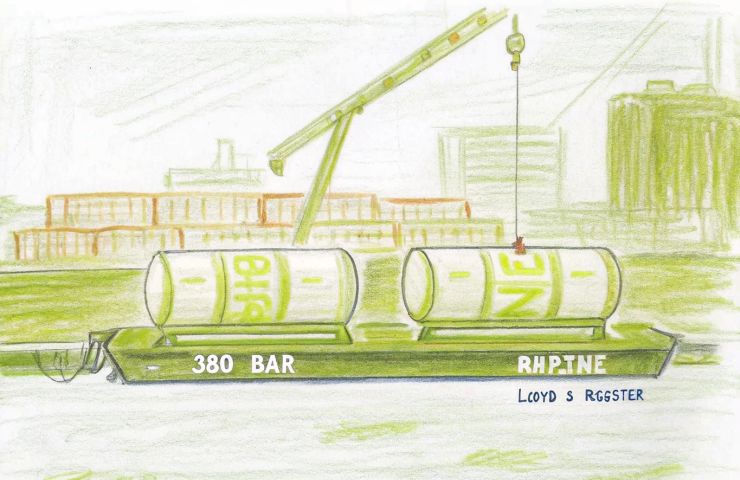
RH2INE recently received a nod of approval from Lloyd's Register, who granted them an Approval in Principle for their cutting-edge design of swappable hydrogen containers along the Rhine corridor. This innovative concept features 20-foot and 40-foot Multiple-Element Gas Containers built to handle 380-bar hydrogen storage. They're set to act as modular fuel units across different logistics areas, including road, rail, and inland waterways. It's a significant leap toward building a solid hydrogen infrastructure that aims to bring zero-emission shipping to inland routes.
Now, earning this Approval in Principle (AiP) is like getting a solid thumbs-up, suggesting that the design could meet regulatory standards without too many bumps along the way. But don't get too excited just yet; it's not a license to operate just yet. The team still has to deal with the nitty-gritty of detailed engineering, production certifications, and various approvals at the port or vessel level. Still, it's a reassuring step that helps clear some of the clouds for shipowners, hydrogen suppliers, and public authorities.
RH2INE started back in 2019 as a cross-border consortium led by Zuid-Holland and North Rhine-Westphalia. It has since expanded to include twelve steering members and over thirty partners hailing from countries such as the Netherlands, Germany, Belgium, France, Switzerland, and Austria. Their mission? To create a market-ready hydrogen system for inland shipping that integrates fuel-cell propulsion, hydrogen supply, port infrastructure, and standardized technical practices. Early studies are already underway, aiming to roll out a fleet of hydrogen vessels, with some demonstration projects currently testing mobile container refueling between Rotterdam and Cologne.
Standardised Swappable Containers
So, what’s the buzz about these containers? They combine standard intermodal sizes with specialized hardware made for handling high-pressure gas. The standard 20-foot and 40-foot frames come equipped with ISO corner castings, making them compatible with cranes and reach stackers at terminals. Inside, you’ll find multiple composite cylinders linked via manifolds and fitted with safety valves to ensure everything operates smoothly. Additional features include burst discs and gas detectors that sync with vessel monitoring systems, all optimized for easy swaps using existing container-handling gear.
Why Swappable Units Matter
When it comes to cleaning up inland shipping, just having hydrogen fuel cells isn’t enough; a reliable supply chain is vital. Traditional refueling stations often require vessels to dock for long stretches, which can throw a spanner in the works when it comes to operational flexibility. Swappable containers can be exchanged quickly, allowing a barge to stay on the move while the empty tanks get refilled elsewhere. This approach fosters a shared pool of resources and helps minimize the heavy investments usually needed for specialized infrastructure. Plus, it fits perfectly with the new hydrogen refueling stations that are emerging at major inland ports and along routes that can handle the transport of full containers from production sites.
Under the Hood: Composite Pressure Vessel Technology
What’s at the core of each container is a set of composite pressure vessels. They have a high-density polymer liner that safely houses the hydrogen, while a fiber-reinforced composite wrap takes on the carry weight. This design keeps the container light and helps prevent hydrogen from leaking or becoming brittle. Companies like NPROXX and Hexagon Purus have subjected these vessels to rigorous tests to ensure reliable performance under 380-bar pressure. And just to be on the safe side, they’ve included leak detection technology, insulation, and pressure management controls, along with corrosion-resistant coatings to protect against the elements.
Collaboration and Standardisation
RH2INE has also set up a working group dedicated to standardization. This initiative brings together industrial gas producers, port operators, tech developers, and classification bodies. Partners like Air Products, Air Liquide, Argo-Anleg, ZBT, and Rheinmetall are all in the mix, helping to outline common interfaces, safety components, and proper handling guidelines. Moreover, the European Industrial Gases Association (EIGA) has been providing valuable input on pressure-gas systems to ensure everything aligns with maritime transport regulations. The result? An open technical standard aimed at achieving seamless multimodal interoperability, complete with recommended inspection intervals, crew training guidelines, and digital monitoring systems for tracking container statuses and fill levels.
Regulatory and Operational Hurdles
But getting that design validation is just the first step in a long journey. Each batch of containers needs to obtain ADR, RID, and ADN approvals for transport via road, rail, and inland waterways. On top of that, the entire vessel installation must comply with sub-system certifications under ES-TRIN and other inland navigation rules. Port authorities will be conducting audits, examining security measures, crew protocols, and emergency plans. When it comes to ensuring hydrogen availability, much depends on green hydrogen production methods—primarily carried out through renewable electrolysis—and how efficient the logistics are in linking filling stations to container depots. While several countries have introduced transitional measures to support initial hydrogen projects, harmonizing inland-waterway rules is still a work in progress.
Strategic Implications
With their AiP now in hand, RH2INE is getting ready for pilot deployments and is even considering launching a leasing division to manage and lease these containers to inland shipping companies. If they pull this off, it could foster a shared pool model that reduces investment risks and circumvents vendor lock-in. But for this to be financially viable, key factors like the cost of green hydrogen, scaling of fuel-cell technologies, and regulatory alignment will be critical. A recent white paper pointed out that shipping costs for hydrogen are currently on the higher side, emphasizing the need for continuous innovation and supportive policies to bring these projects to life.
Looking Ahead
This design validation marks a substantial shift, moving from ambitious plans to tangible implementation. Next up, we’ll see real-world testing of container handling, vessel integration, and supply chain coordination. As Europe pushes ahead with its zero-emission corridors and green shipping initiatives, these swappable hydrogen containers could play a pivotal role in decarbonizing inland waterways, ultimately helping to lay the groundwork for a practical and scalable hydrogen infrastructure along the Rhine and beyond.