INPEX, BASF, and JGC's Integrated Blue Hydrogen and Ammonia Project Begins Operations in Japan
The INPEX Corporation's Kashiwazaki Hydrogen Park has launched a groundbreaking project integrating hydrogen and ammonia production with carbon capture, showcasing new technologies and strategic advancements in Japan's energy transition.
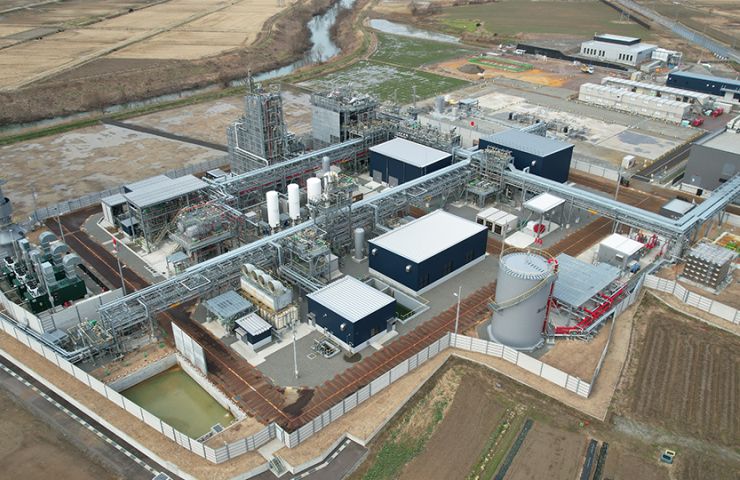
Recently, BASF and JGC announced that their HiPACT carbon-dioxide capture technology successfully passed a performance test at INPEX Corporation's Kashiwazaki Hydrogen Park in Niigata Prefecture, Japan. The announcement marks a milestone for a demonstration project that aims to produce hydrogen and ammonia from domestic natural gas while capturing the resultant carbon dioxide for underground injection. It is, on paper, a compact value chain: gas in, hydrogen and ammonia out, and CO2 sequestered. The significance lies in proving each link under operating conditions rather than only in laboratory trials.
INPEX is both the owner and operator of this project and plans to achieve an annual production capacity of approximately 700 tonnes of hydrogen. Of that output, roughly 600 tonnes are earmarked for hydrogen-based power generation, while an estimated 100 tonnes will be converted into 500 tonnes of ammonia intended for local customers. According to recent reports, hydrogen production commenced in June, carbon-dioxide injection operations started in August and ammonia production began shortly thereafter. Those dates frame the transition from test runs to sustained operation at the demonstration scale.
Technological Innovations
The HiPACT technology is central to the facility's design and operation. It uses a proprietary chemical-absorption solvent to capture carbon dioxide from the process gas and regenerates that solvent at high pressure. That approach is said to reduce the energy needed both to capture CO2 and to compress it for storage, potentially offering a cost reduction of up to 35% compared to conventional technologies. Crucially, this percentage is presented as an engineering estimate rather than as the outcome of verified financial results. In other words, the figure points to potential savings; it does not yet stand as audited commercial performance.
Strategic Implications for the Industry
On a strategic level, the demonstration highlights Japan's focus on energy security even as the country seeks lower-carbon pathways. With limited domestic energy resources, Japan is increasingly focused on producing and using both blue hydrogen and blue ammonia as components of its decarbonization efforts. Policymakers and industry actors are watching projects such as this closely because they combine existing fuel sources with emissions-management measures, rather than relying solely on entirely new supply chains.
The project also shows how different technologies can be combined within a single site. It integrates natural-gas-based hydrogen production, carbon capture and storage (CCS), and hydrogen-fired electricity generation into one facility. That integration is not merely an engineering convenience; it is a way to test whether system elements can operate in concert under real-world conditions and whether that configuration can form the basis of a regional hydrogen ecosystem.
Environmental Considerations
Environmental performance is a stated objective of the demonstration. Project planners aim to capture approximately 5,500 tonnes of carbon dioxide annually for underground injection, which would reduce potential atmospheric emissions if achieved at scale. Yet important questions remain open. Critical parameters such as methane leakage during natural-gas extraction and the overall lifecycle emissions related to blue hydrogen production need independent evaluation. Success, therefore, will depend not only on meeting operational targets but also on third-party verification of environmental claims.
Operating Context and Future Prospects
The initiative has already drawn interest from local industry. Mitsubishi Gas Chemical has been identified as a recipient of the ammonia produced, a development that underscores the project’s immediate role in the local hydrogen economy and hints at possible commercial linkages beyond the demonstration phase. Local offtake by established chemical firms can ease the transition from pilot operations to broader commercial deployment, should the technical and environmental credentials be confirmed.
More broadly, INPEX's initiative provides a reference case for both carbon capture technologies and the integration of hydrogen production within an energy system. As a demonstration, it gathers operational and technical experience that could inform future projects that adopt a similar model. While the effort remains at a demonstration scale, the lessons learned—on technology, logistics, and environmental monitoring—could help refine the processes necessary to assess commercial viability and to guide further deployments in Japan and elsewhere.