India’s Green Hydrogen Production Stumbles on Standards Gaps, BCG Warns
BCG and India’s MNRE mapped 166 standards across 20 components, flagging 23 gaps in green hydrogen production, transport, storage and end uses, and proposed adopt/adapt/develop routes.
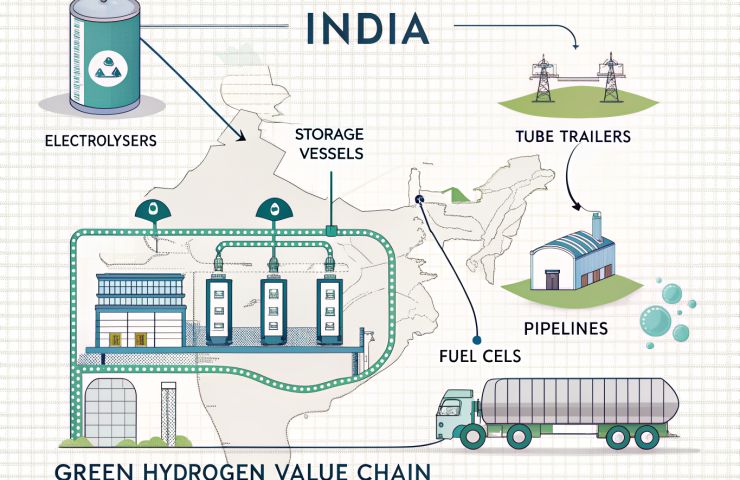
Boston Consulting Group’s standards gap assessment, prepared with the Ministry of New and Renewable Energy, maps India’s green hydrogen value chain into 20 components and 50 sub-components, flagging 23 areas without a usable Indian standard.
Raw Inventory
Released at MNRE’s World Hydrogen and Fuel Cell Day event in New Delhi, the report—authored by Anirban Mukherjee, Siddharth Jain, Ashish Kulkarni, Lakshya Nyshadham and Gurjas Sahney—is the first structured inventory of India’s hydrogen standards landscape. BCG painstakingly mapped 20 value-chain components and 50 sub-components, identifying 166 relevant standards, codes and reference documents. Of these sub-components, 12 have no gap, 15 show partial coverage and 23 lack a usable Indian standard. Benchmarking against Canada, Germany and the European Union shows India trailing peers in areas such as pipeline integrity, end-use codification and safety protocols. The document is emphatically a diagnostic, not a rulebook; it lays bare where domestic rulemaking must catch up.
Production Standards
Green hydrogen production depends on tightly specified norms across water pre-treatment, electrolysis cell design, electrical wiring, pressure regulation, sensors and emissions accounting. According to BCG, Indian codes cover general electrical safety and boiler rules but stop short of prescribing specifications for membrane-electrode assemblies, catalyst coatings or electrolyte handling procedures. The assessment also flags the absence of well-to-gate lifecycle accounting norms in Indian regulation, even though MNRE’s Green Hydrogen Certification Scheme sets a 2 kgCO₂-eq/kg-H₂ threshold. Without standardised test protocols for carbon-intensity measurement, developers will struggle to generate certificates that insurers and banks can trust. Control-system software, remote monitoring, cybersecurity requirements and maintenance schedules for electrolysers are similarly under-specified. BCG recommends leaning on IEC and ISO frameworks where they are valid, but tailoring them to India’s grid variability, monsoon-wet conditions and local manufacturing capabilities to avoid a one-size-fits-all outcome.
Storage and Transport
Storing and moving hydrogen raises further demands for bespoke material and safety standards. Compressed hydrogen, typically handled at 350–700 bar, requires pressure vessels made from alloys that resist hydrogen embrittlement under cyclic loading. PESO governs pressure-vessel certification, yet India lacks detailed protocols for fatigue testing with hydrogen, for sensor calibration in leak detection and for maintenance intervals. Road transit in tube trailers needs clear standards on trailer design, weight limits, separation distances at loading sites and emergency-shutdown procedures. Dedicated hydrogen pipelines are still nascent; repurposing natural-gas lines without embrittlement risk assessments could invite failures. PNGRB oversees gas transmission, but no hydrogen-specific pipeline integrity code exists. Underground storage caverns—important for seasonal buffering—remain unregulated. BCG highlights the need for separate inspection regimes, defined safety zones around high-pressure installations and closer alignment with international best practices to de-risk capex in storage and transport.
End Uses and Certification
End-use segments—ranging from heavy-duty vehicles and off-road equipment to stationary fuel cells, industrial furnaces and maritime bunkering—carry diverse purity, pressure and interface requirements. BCG points out that India has adopted ISO 14687 for hydrogen quality but has not introduced national adjustments for local feedwater impurities or specific contaminant thresholds for fuel cells in rail or port operations. Aviation and marine fuel cells sit outside formal codes, exposing early movers to project-by-project approvals. The Green Hydrogen Certification Scheme sets out measurement, reporting and verification steps for production, but it does not extend to end-use emissions accounting or cross-chain traceability. Absent clear standards for connectors, refuelling protocols and onboard storage in vans or trains, operators could face delays and insurance hurdles. BCG recommends adopting EU and ASTM guidelines that are proven, while adapting them to India’s thermal profiles and supply-chain security needs.
Regulatory Bodies in Play
MNRE leads policy under the National Green Hydrogen Mission, which aims for at least 5 million metric tonnes of capacity by 2030 with a budget of ₹19,744 crore, according to government documents. BIS holds the technical-standards mandate but has yet to publish hydrogen-specific codes beyond foundational gas and materials standards. Safety regulators PESO and the Oil Industry Safety Directorate convened in October at an MNRE event but acknowledged that no single consolidated hydrogen safety code exists. PNGRB is exploring draft amendments to its pipeline regulations for hydrogen blending and dedicated lines, while SECI secures auction structures linking renewable power to hydrogen projects. Research bodies like CEEW contribute policy analysis, yet final sign-off responsibility is spread across multiple ministries—power, petroleum, steel and even civil aviation—raising the risk of jurisdictional overlap and delay.
Trade Implications
India’s domestic MRV and certification framework supports local incentives, but BCG warns it does not automatically clear export hurdles. Under the European Union’s Renewable Energy Directive II, hydrogen exporters must meet additional criteria on renewable electricity sourcing, temporal correlation of generation and grid balancing. The mismatch creates a dual-track process: Indian certificates for domestic use and separate validation for EU buyers. Mutual recognition agreements or a harmonised set of standards could eliminate duplicate audits, but that depends on technical alignment around emissions metrics, traceability logs and conformity-assessment procedures. Canada and Germany have preliminary work on equivalence; BCG says India could accelerate export readiness by formally benchmarking its certification scheme against these jurisdictions and publishing interoperability guidelines.
Why Standards Matter
Each component—electrolysers, compressors, storage vessels, pipelines, refuellers and fuel cells—represents capital expenditure often running into hundreds of millions per project. In the absence of clear, harmonised standards, lenders will demand contingency buffers, pushing up the cost of debt or stalling approvals. BCG flags that domestic manufacturing of stack components and pressure vessels cannot scale if suppliers face ambiguous quality benchmarks. Developers may default to costly international vendors certified under ISO or ASTM, undercutting India’s Make in India ambitions. Insurance underwriters, too, require documented safety procedures and inspection intervals; gaps in standards translate directly into higher insurance premiums. For a mission projecting more than ₹8 lakh crore in investment and 600,000 new jobs by 2030, insecure standards threaten to convert planned deployment into a patchwork of high-cost trials.
The Road Ahead
To bridge these gaps, BCG prescribes a three-route strategy: first, adopt established international codes where domestic conditions align; second, adapt standards by embedding India-specific parameters such as humidity limits, seismic resilience and water-quality thresholds; third, develop new national standards where no external benchmark exists. Critical enablers include capacity building in State-level testing laboratories, fast-track accreditation of third-party certifiers, digital access to standards repositories and a centralised approvals portal. BCG also calls for targeted training programs for inspectors, first responders and plant operators. The proposed framework is neither lightweight nor rapid. It envisages a phased rollout across priority segments, beginning with production and transport, then extending to end-uses and safety, subject to annual progress reviews by MNRE and BIS.
Critical Lens
Let’s face it: centralised committees and inter-ministerial working groups rarely move at the speed of markets. Drafting 23 new standards, revising 15 partially covered sub-components and aligning dozens more with ISO or IEC will take years. I doubt regulators will complete this by mid-decade. Meanwhile, project developers will not wait — they will lean on international certifications, carve out bespoke approval paths and possibly migrate to jurisdictions with clearer rules. That fragmentation undermines domestic equipment makers, deters banks seeking standardisation comfort and rewards foreign suppliers. If India truly wants an export-ready, Make in India hydrogen ecosystem, bureaucratic agility must match policy ambition.
Closing
India’s green hydrogen vision is bold, but execution hinges on a tangle of technical codes, safety rules and certification regimes. The BCG-MNRE assessment lays this underbelly bare, offering a structured roadmap of what needs to happen next. Whether New Delhi can turn that inventory into a coherent, enforceable playbook—and resist the urge to kick standards decisions down the road—will determine if 5 million tonnes by 2030 is an industry-building benchmark or a missed policy promise.