Hydrogen Data Centers: SK eternix and Mastern Plan Fuel-Cell-Powered AI Hyperscale Facility
SK eternix and Mastern Investment Management signed an MOU to explore a fuel-cell-linked hyperscale AI data center in Seoul, with SK eternix providing fuel-cell infrastructure and Mastern leading site and investment, though key details remain in the feasibility stage.
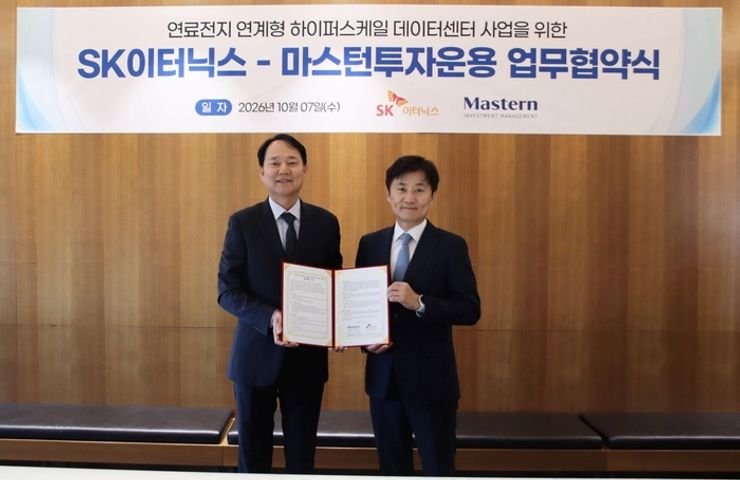
SK eternix Co., Ltd. and Mastern Investment Management have signed a memorandum of understanding in Seocho-gu, Seoul to jointly explore what the companies describe as South Korea’s first fuel-cell-linked hyperscale artificial intelligence data center, according to an announcement by the parties. The pact pairs a renewable-energy developer with an alternative-investment asset manager. Together they will test an integrated generation-and-compute model arranged to operate off-grid.
Project Overview
The proposed model places stationary fuel-cell generation modules directly at the data-center site and ties them into the building’s electrical system behind the switchgear. Electricity would flow from the on-site power plant under a dedicated power purchase agreement (PPA) instead of depending on a new external grid connection. The intent is to address grid constraints in dense urban markets and to supply continuous, high-quality power for intensive AI workloads.
Roles and Responsibilities
According to several business-news reports, SK eternix will serve as the power-system developer, taking responsibility for project finance, fuel-cell facility design, engineering, procurement and construction (EPC), as well as operations and maintenance. Launched in March 2024, the company operates across the renewable-energy value chain and reports five stationary fuel-cell sites totaling 89 MW, while holding domestic supply rights for Bloom Energy fuel-cell technology. Its existing fuel-cell projects include Paju Eco Green and Chilgok Eco Park, demonstrating its experience with modular generation assets. In parallel, Mastern Investment Management will lead real-estate development: securing the data-center site, navigating permitting processes, defining the facility’s scale and design, structuring investment, arranging financing and recruiting tenants. Mastern has been linked to an urban data-center initiative in Seoul’s Yeongdeungpo-gu district, though no construction or final site decision has been disclosed for that effort.
Technical Model
The backbone of the concept is stationary fuel cell power generation, which converts hydrogen and oxygen into electricity via an electrochemical reaction without conventional combustion. In a typical system, hydrogen is supplied to an anode and oxygen to a cathode, with an electrolyte allowing ions to pass and forcing electrons through an external circuit to produce power and heat. Commercial installations may receive pure hydrogen or include on-site fuel processing to extract hydrogen from natural gas. The proposal leaves open whether equipment such as Bloom Energy solid oxide fuel cells will be selected and what fuel type—green hydrogen versus hydrocarbon-derived feedstock—will be used.
Power-Purchase Agreement Dynamics
A PPA would formalize the relationship between the fuel-cell generator and the data-center operator. Expect the contract to specify power volume, price, term, performance obligations, metering, scheduled outages and treatment of fuel-cost variations and environmental attributes. The announcement did not identify the offtaker or contract terms. Still, a PPA of this kind is intended to provide revenue certainty for investors and predictable energy costs for the data-center tenant.
Grid Independence and Redundancy
Placing generation behind the site’s switchgear and transformers can reduce dependence on external grid upgrades and long interconnection lead times. High-density AI computing, however, demands robust redundancy and fast response. The project’s design likely will include uninterruptible power supplies (UPS), batteries and standby generators to manage rapid load changes, maintenance outages or fuel-cell shutdowns, though the MOU does not disclose details of voltage regulation, load-following capabilities or resilience standards. Fuel cells deliver steady baseload power. Instantaneous response to load spikes typically relies on battery energy storage or UPS systems, which are already standard in data-center design; integrating these components effectively will be critical to meet AI performance requirements.
Environmental Considerations
Fuel cells offer lower local emissions of pollutants and noise compared with combustion-based generators, and they can require less land and water. Carbon impacts, however, hinge on the hydrogen supply chain. Green hydrogen produced via renewable-powered electrolysis could minimize lifecycle emissions, while hydrogen from natural gas with or without carbon capture retains upstream greenhouse-gas output. Any large data center will also have embodied emissions from construction and water demands for cooling; integrating waste-heat recovery or low-water cooling will be vital to minimize overall environmental footprint. Safe storage and delivery logistics, heat-rejection strategies and backup-generation fuel sources will all influence the facility’s overall sustainability profile.
Regulatory and Policy Context
South Korea’s national hydrogen roadmap, first outlined in 2019, set targets for stationary fuel-cell power deployment alongside fuel-cell vehicles, and the Renewable Portfolio Standard has classified certain fuel-cell generation as eligible. Nevertheless, this specific project will require land-use and building permits, environmental impact reviews, electrical safety and fire-protection clearances, fuel-supply approvals and adherence to private electricity-supply regulations. National policy may offer incentives under the hydrogen strategy, but private off-grid arrangements remain subject to detailed regulatory scrutiny across energy, environment and building authorities.
Market Drivers
The hyperscale AI sector is driving a surge in demand for premium power. The International Energy Agency projects that global data-center electricity consumption could nearly double by 2030, with AI-focused facilities growing even faster. In regions where grid capacity is saturated or interconnection timelines are uncertain, on-site generation using hydrogen fuel cells emerges as a potential alternative to diesel backup sets, battery energy storage or dedicated utility connections. Pilot projects coupling solar and battery storage in microgrids are already underway in other markets as data-center operators test distributed energy solutions, positioning hydrogen fuel cells as one of several emerging options in the search for reliable power infrastructure.
Strategic Implications
If realized, the SK eternix–Mastern model could offer a bundled infrastructure product combining generation, real estate, financing and power-supply commitments. That integration may appeal to investors seeking contracted returns backed by physical assets, while giving tenants long-term visibility on energy costs and reliability. The approach could support blended financing structures that combine infrastructure debt, equity and long-term PPA revenue streams, potentially attracting a broader investor base beyond traditional real-estate funds. Economics, however, remain sensitive to hydrogen pricing, equipment replacement costs, financing rates and actual tenant demand, and any delays in permitting or fuel-supply agreements could materially affect project viability.
Comparison with Alternative Solutions
Some data centers have already begun pairing battery energy storage systems with intermittent renewables to provide firm power, while others rely on on-site gas turbines or dual-fuel engines. The SK eternix–Mastern fuel-cell concept distinguishes itself by promising lower local pollutants and quieter operation, but it must compete on total cost of ownership, installation footprint and the maturity of fuel-cell technology relative to more established alternatives.
Feasibility and Next Steps
The companies said the MOU represents a feasibility-stage agreement rather than a final investment decision. Next steps include selecting a specific site, completing detailed engineering design, confirming the hydrogen source and fuel logistics, finalizing PPA terms, securing financing, obtaining permits and lining up tenant commitments. The parties plan to refine the business model and assess technical and economic feasibility over the coming months, with detailed engineering and financial analyses expected before any final decision to construct the facility.
Outlook for Hydrogen Data Centers
This memorandum marks an early test case for hydrogen data centers in South Korea, at the intersection of advanced computing and emerging hydrogen energy systems. Whether it paves the way for a broader shift to on-site fuel-cell generation in data-center development will depend on transparent feasibility outcomes, cost competitiveness and proven reliability under demanding AI workloads.