Enagás Emprende Invests in digHy’s Renewable-Hydrogen Project Design Software
Enagás Emprende has become a shareholder in digHy to support development of its SaaS platform for designing, simulating and certifying renewable-hydrogen and Power-to-X projects, though financial terms remain undisclosed.
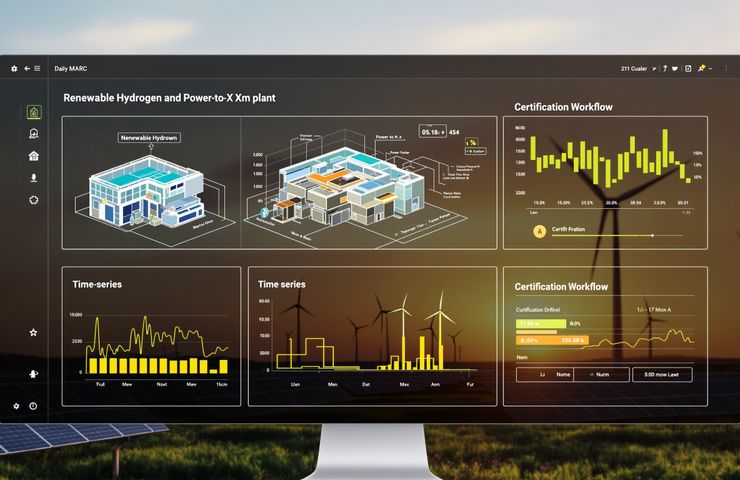
Enagás Emprende, the corporate-venture arm of Enagás, has acquired a stake in digHy, a Galician technology startup based in Pontevedra, to accelerate its SaaS platform for renewable-hydrogen and Power-to-X project development. According to Enagás Emprende, the investment will fund enhancements to digHy’s design tool, development of an operations module and automation of sustainability-certification workflows. The transaction amount, acquired equity stake and governance arrangements were not disclosed, consistent with confidentiality in early-stage venture deals.
Platform Capabilities and Technical Details
digHy Design is marketed as a digital end-to-end solution for developers evaluating renewable-hydrogen and Power-to-X plants. The platform integrates geospatial analytics for site selection, hourly solar and wind resource data, a library of electrolyzer and conversion-unit models covering ammonia, methanol, e-methane and sustainable aviation fuel synthesis, and a process-chain simulation engine. Developers can import local meteorological time series, select electrolyzer types (PEM or alkaline), adjust component sizing—from kilowatt-scale units to multi-megawatt reactors—and simulate plant behavior over its expected lifecycle.
According to company statements, an embedded optimization module evaluates multiple scenarios on technical indicators such as capacity factor and overall efficiency, alongside economic metrics like levelized cost of hydrogen (LCOH) and derivative-product returns. The platform’s automated report generator compiles data lineage and assumptions into customizable technical dossiers for financing institutions, certification bodies and public-aid agencies. A forthcoming operations module aims to provide real-time dispatch optimization, maintenance alerts and performance analytics, while an automated certification workflow is planned to collect metered electricity consumption, power-purchase agreement details and lifecycle-emissions data in line with EU additionality and correlation requirements.
While public sources do not disclose the software architecture, algorithmic methods or data providers, digHy’s end-to-end approach is designed to reduce duplicated engineering effort and ensure consistency between feasibility studies and detailed design packages. Independent validation against operating plants has not yet been reported, leaving proof-of-concept trials pending real-world deployment.
Strategic Rationale
Enagás, long established in Spain’s natural-gas transmission and storage networks, is pivoting toward low-emissions gases through its corporate-venture programme. According to official documentation, Enagás Emprende invests in startups focused on renewable gases, digitalization, energy efficiency and sustainability, offering equity funding, mentoring, technological validation and industrial partnerships. The corporate-venture arm positions these activities as a way to build technological familiarity and to spot integration opportunities early.
By becoming a shareholder in digHy, Enagás Emprende gains early insight into digital tools and project pipelines that could integrate with its future hydrogen infrastructure. Brais Armiño, identified as digHy’s CEO and co-founder, argues that conventional analyses often silo resource availability, electrolysis operation and certification compliance, leading to fragmented workflows and potential design mismatches. The partnership aims to align digHy’s software roadmap with Enagás’s strategic goal of fostering a credible pipeline of projects for its planned hydrogen network.
Regulatory and Market Context
European rules for renewable hydrogen, defined as RFNBOs (renewable fuels of non-biological origin), impose strict criteria on additionality—requiring that renewable power be newly built for the project—and mandate temporal and geographic correlation between electricity sourcing and hydrogen production. Voluntary certification schemes recognized by the European Commission can issue certificates if traceable, time-resolved data are provided and third-party audits are passed. digHy’s planned certification module seeks to automate evidence collection, though it has not yet been approved or used to generate recognized certificates.
Spain’s updated hydrogen roadmap targets 12 GW of electrolyzer capacity by 2030, supported by funding programmes such as the PERTE for Renewable Hydrogen, Renewable Energies and Storage. Despite these initiatives, the International Energy Agency reports that low-emissions hydrogen still faces a sizeable cost gap compared to fossil-based routes, while off-take agreements and financing remain uncertain. Developers must also navigate grid interconnection delays, water-resource availability and permitting timelines, complexities that integrated software tools aim to address.
Comparative Industry Landscape
Digital solutions for hydrogen project planning are proliferating, but they often focus on discrete scopes—either resource forecasting or financial modeling. Few platforms extend simulation through Power-to-X synthesis and automated documentation. digHy positions itself at this intersection, targeting workflows from initial site screening through to financing support, a niche that remains relatively untapped in the hydrogen sector.
Implications for Developers and Investors
High-resolution resource modeling and dynamic cost comparisons could enable developers to reject non-viable sites earlier, concentrating investment on technically credible locations. Investors and lenders may value the platform’s comprehensive audit trail, which preserves parameter settings, data sources and simulation outputs, potentially streamlining due diligence. That audit trail is presented as a way to reduce back-and-forth between engineering teams and financiers, shortening the path from concept to capital allocation.
However, credibility hinges on the accuracy of underlying algorithms and real-world validation. digHy has not yet published independent case studies or measured performance improvements in operating installations. Environmental factors—regional water stress, land-use demands and lifecycle-material impacts—also shape feasibility. According to academic research, water scarcity must be factored into large-scale electrolysis strategies, and digHy’s software reportedly allows users to incorporate these constraints, though the extent of environmental-module development remains company-described.
Outlook
Enagás Emprende’s investment illustrates the convergence of digital innovation and infrastructure planning in Europe’s emerging hydrogen market. If digHy’s platform gains adoption, secures third-party certification and integrates into engineering and finance workflows, it could streamline feasibility studies, design iterations and regulatory compliance, improving project bankability. The ultimate test will be the software’s ability to deliver auditable, accurate models that reflect real operating conditions and satisfy both technical and regulatory stakeholders.