Germany's Hydrogen Core Network: A Step Toward Operational Reality
Germany's hydrogen core network is advancing with 537 kilometers of operational pipelines. The GET H2 Nukleus initiative has enabled hydrogen transport to key industrial players, reflecting the network's importance in decarbonization efforts, though challenges remain.
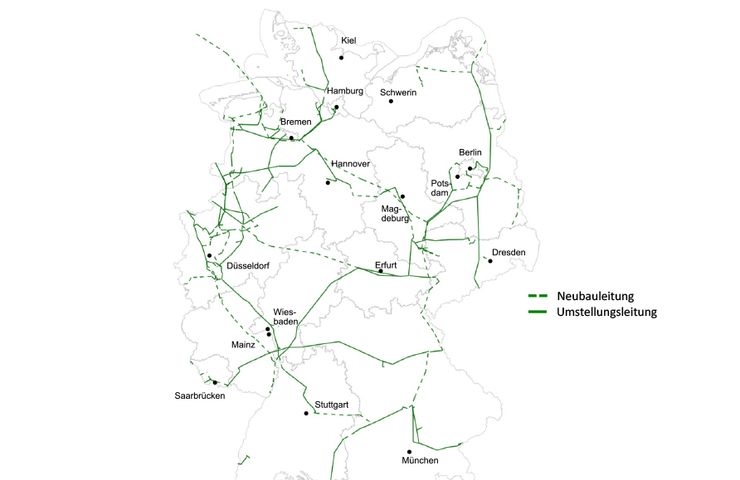
Germany's hydrogen infrastructure is making strides as the nation transitions towards a greener energy system. Just two years after receiving approval, operational hydrogen pipelines have reached 537 kilometers, connecting initial industrial customers to a planned 9,040-kilometer hydrogen core network. That figure — 537 kilometres now online against a 9,040-kilometre blueprint — underlines the scale of the programme and the ambition behind it. The network is not an isolated engineering exercise. It is designed to stitch together where hydrogen will be made, where it can be stored and where it will be consumed, and to do so at industrial scale rather than as a series of scattered pilots. Early sections already in service serve a practical purpose: they connect production points to nearby users so companies can test flows, operational procedures and safety regimes in real conditions. At the same time, the programme’s scale makes clear that more than a few sections of pipe will be needed before hydrogen reaches a wide set of industrial customers across the country.
Core Network Summary
The approved hydrogen core network aims to interlink production sites, storage facilities, and significant industrial consumers across Germany, requiring an estimated investment of €18.9 billion. That investment estimate — €18.9 billion — frames the financial dimension of building a national backbone rather than a local set of connections. Around 60% of this network will be established through the conversion of existing natural gas pipelines, a detail that shapes both cost and construction timelines. Reusing pipeline corridors can lower the need for new land rights and reduce excavation, but it also brings technical and regulatory work: pipelines designed for natural gas must be assessed, adapted and certified for hydrogen service. The balance between conversion and new-build sections will affect deployment speed and the types of upgrades operators must undertake. In short, the €18.9 billion figure and the roughly 60% conversion share signal a hybrid approach — one that relies heavily on repurposing existing assets while still requiring substantial new infrastructure and capital.
Key Developments Highlighted
The GET H2 Nukleus initiative exemplifies the project's progress. Recently, hydrogen produced at RWE's electrolysis facilities in Lingen successfully reached the Evonik chemical park in Marl via a 120-kilometre pipeline. The movement of hydrogen along that 120-kilometre route demonstrates a functioning link between a production site and a major chemical consumer. Separately, ONTRAS has completed a 25-kilometre pipeline between the Bad Lauchstädt Energy Park and TotalEnergies' refinery in Leuna, capable of transporting approximately 2,700 tonnes of green hydrogen annually. That 25-kilometre section is already dimensioned to move roughly 2,700 tonnes per year, a concrete transport capacity that allows an industrial user to test consumption patterns and assess how hydrogen integrates with existing processes. Together, these segments show more than isolated experiments: they are working examples of how electrolysis output can be conveyed to chemical parks and refineries, and how operators are beginning to map the physical routes that a larger core network will one day include.
What This Means
These developments prove that Germany is testing the integration of hydrogen production, transport, and industrial utilization. The practical tests underway are intended to validate technical interoperability — from electrolyser output to pipeline transmission and end‑use handling — under real operating conditions. This calls for a profound transformation not only in energy production but also in industrial operations across sectors that currently emit high levels of CO2. Such a transformation will require companies to adapt processes, retrofit equipment and reorganise supply chains to accept hydrogen as a feedstock or fuel. Equally, it requires planners to coordinate where production is located relative to demand and to think through how storage will be used to balance intermittent supply from electrolysers powered by renewables. The early pipelines provide a learning ground for all of these issues, allowing operators to identify technical, logistical and operational bottlenecks before scales are ramped up across the planned 9,040-kilometre network.
Financial and Regulatory Dimensions
Backed by the Federal Network Agency and the Federal Ministry for Economic Affairs and Energy, these initiatives still face uncertainty around financing and industrial demand. The institutional backing confirms this is a strategic national endeavour, but it does not remove important questions about who ultimately pays for the network and how quickly industrial users will convert processes to use hydrogen. If hydrogen supply and user commitments do not materialize, there could be a shift of costs to the public sector or future users under the current financing model. That possibility highlights two intertwined risks: the first is a financing risk tied to the willingness of private actors to underwrite pipelines and associated assets; the second is a demand risk tied to industrial buyers committing to long‑term offtake volumes. Both risks influence how projects are structured, how contracts are written and how regulators design tariffs or support mechanisms. For planners, the challenge is to balance incentives, timelines and safeguards so the core network can be rolled out without exposing taxpayers or incumbent users to disproportionate costs if adoption lags.
Moving Forward
While the infrastructure is being laid out, the real challenge lies in ensuring that sufficient hydrogen is produced at competitive prices and that industrial users are ready to transition to this renewable source. Meeting those two conditions — supply at competitive cost and credible, large-scale industrial uptake — will determine whether the pipeline sections in place remain pilots or become the veins of a broader market. The journey toward an efficient hydrogen economy will be crucial to meet Germany’s decarbonization goals. That journey will involve aligning investment decisions with industrial strategies, confirming the technical integrity of converted pipelines, and establishing commercial arrangements that create predictable cash flows for project developers. In practical terms, the next phases must show that electrolysers can be deployed at scale, that transport capacity aligns with actual consumption patterns, and that end users can plan their own transitions around reliable hydrogen supplies. Only then will the planned 9,040-kilometre core network move from blueprint to a functioning backbone of a lower‑carbon industrial sector.